
The hacker didn’t need to break Aave. They just needed to use it.
On October 29, while billions of dollars were being drained from Binance, a wallet linked to the attack made what looked, mechanically, like an ordinary decentralized finance transaction: deposit $60 million in USDT, borrow 19,762 wrapped Ether, and move on.
The loan was worth about $44.6 million. It was backed by sufficient collateral. And it went through.
Less than an hour later, Aave began freezing lending reserves across multiple blockchains. By the time its emergency response finished, 292 reserves had been locked against new deposits and borrowing.
The episode exposed a problem that doesn’t fit neatly into the usual exchange-hack headlines. Aave wasn’t compromised, and its lenders weren’t reported to have lost money to the attacker’s position. But preventing stolen assets from circulating through its lending markets introduced another kind of risk: ordinary borrowers facing rising interest rates as liquidity drained from frozen reserves.
Ravel’s analysis of 23 lending reserve and hub-asset snapshots suggests that emergency interest-rate adjustments could change annualized borrowing costs by the equivalent of roughly $406,000 per day under the published single-step implementation specifications.
That isn’t a confirmed loss or realized saving. It is a snapshot-based model of how much the proposed parameters could change interest accrual, assuming borrowing balances remained constant.
The more revealing question is why such adjustments became necessary in the first place.
The $44.6 Million Loan That Triggered a Much Bigger Response
The Binance breach unfolded quickly.
At 20:24 UTC on October 29, one Ethereum hot wallet sent 167,464 ETH and dozens of other tokens to an attacker-controlled address. Another Binance wallet transferred 28,006 ETH shortly afterward, while suspicious movements appeared across several other networks.
Binance subsequently disclosed an estimated $6.3 billion impact, saying an initial investigation pointed to a compromised DevOps engineer’s laptop and unauthorized withdrawal transactions. The exchange reported that it had frozen around $3 billion in affected assets and promised to cover losses using company funds and its SAFU reserve.
But some of the stolen assets had already found their way into DeFi.
According to LlamaRisk’s incident report, one wallet in the attacker’s cluster supplied $60 million in USDT to Aave V3’s Ethereum Core market between 20:58 and 21:01 UTC, then borrowed 19,762 WETH.
The wallet identified in the investigation wasn’t exploiting a lending-contract vulnerability. It was accessing available liquidity through Aave’s normal borrowing mechanics.
At LlamaRisk’s subsequent snapshot, the position retained about $59.9 million in collateral against $43.8 million in debt. It remained overcollateralized and subject to liquidation.
That distinction matters. The attacker’s activity showed how stolen assets could move through a fully functioning lending protocol without anyone needing to hack Aave itself.
Aave’s risk team responded by joining an emergency coordination group involving Aave Labs and other service providers. The group concluded that freezing only reserves holding known stolen tokens would leave alternative routes open: the attacker could simply exchange those tokens for other accepted collateral.
Aave executed its first freeze transaction at 21:42 UTC. By 23:04 UTC, the protocol had frozen 175 reserves across Aave V3 and another 117 across Aave V4.
These were 292 reserve instances, not 292 separate lending platforms.
Users could still withdraw funds, repay loans, and face liquidation. What they could no longer do was supply new liquidity or open new borrowing positions in the frozen reserves.
And that created an unusual imbalance.
When the Doors Closed, Borrowing Got More Expensive
Lending markets depend on liquidity moving in both directions.
When available liquidity becomes scarce, utilization rises. Higher utilization typically pushes borrowing rates upward, encouraging new suppliers to deposit assets and restoring balance.
Except Aave’s emergency freeze had disabled that second part of the mechanism.
Suppliers could withdraw, but new deposits were blocked. As liquidity left, utilization climbed without the usual ability for incoming deposits to relieve the shortage.
By 00:26 UTC on October 30, some affected reserves were operating at 92% to 100% utilization, according to LlamaRisk’s emergency interest-rate proposal.
Borrowing APRs in several markets had reached double digits. On Aave V3 Monad, mUSD borrowers faced a quoted 36.1% APR, while USDC borrowing rates stood at 20.2%.
The risk team proposed reducing Slope2, the steep portion of the variable interest-rate curve that applies when utilization rises above its optimal level.
Ravel reconstructed the proposal’s financial implications using the supplied balances, utilization ratios, and borrowing rates disclosed in its tables.
The calculation is straightforward: estimate outstanding borrowing from supplied assets and utilization, multiply that exposure by the difference between the current and proposed APRs, then divide by 365.
Across 16 Aave V3 reserves and seven Aave V4 hub-asset entries, the published rate-projection tables imply a $410,782 daily difference in annualized interest accrual.
However, that figure has a caveat.
Two proposed GHO rate adjustments do not match the implementation specifications published in the same document. Recalculating those entries according to the specified parameter changes reduces the modeled difference to $405,852 per day.
More importantly, the impact varies considerably across lending markets.
Aave V3 Core USDC accounts for roughly $160,553 of that modeled daily difference. Plasma USDT0 contributes another $87,041. Together, those two reserves represent about 61% of the revised total.
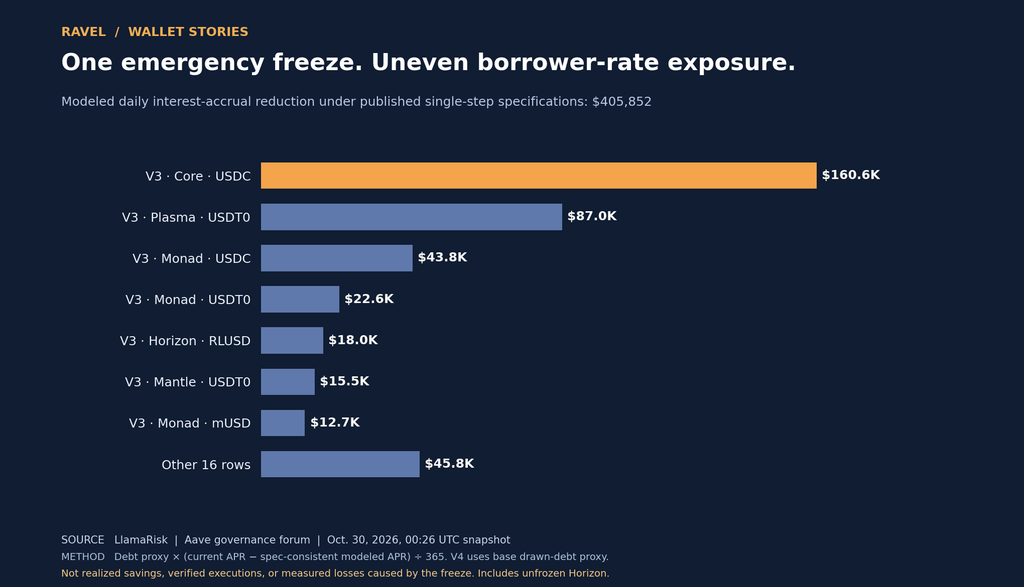
These numbers are not evidence that Aave borrowers actually lost $405,852 on October 30. They illustrate how the emergency rate proposal could change interest accrual, assuming the specified parameters took effect while borrowing balances remained unchanged from the snapshot.
The model also includes Horizon’s RLUSD market, which wasn’t frozen but experienced related liquidity pressures. For Aave V4, it estimates base borrowing interest using hub-level data rather than accounting for every collateral-specific risk premium.
However, the model cannot determine how much the freeze itself drove up borrowing costs versus broader market movements and liquidity withdrawals.
Nevertheless, the underlying mechanism is clear: an emergency measure designed to prevent new exposure to stolen funds left existing borrowers operating in markets where liquidity could exit but not enter.
Aave’s risk team recognized that problem and moved to reduce its severity.
A 10% Interest-Rate Ceiling With Its Own Limits
The interest-rate proposal aimed to bring borrowing APRs at full utilization down to 10% across the selected reserves.
But the implementation details revealed a complication.
Under Aave’s governance framework, a standard Risk Steward can adjust Slope2 by no more than 20 percentage points per update, subject to a 72-hour cooldown. GHO-specific stewards face a tighter limit of five percentage points per update and a one-day cooldown.
Those limits are intentional safeguards against excessive changes to protocol parameters.
They also restrict how much emergency intervention can accomplish in one move.
For example, the proposal would reduce the maximum borrowing APR on Core DAI from 40% to 20%, rather than 10%. Core USDtb would remain at 34%, Monad mUSD at 25%, and Aave V4 Ethereum Core frxUSD at 19%.
The GHO entries reveal a further discrepancy.
For Plasma GHO, the proposal’s summary describes reducing Slope2 from 16.5% to 5.25%. Its implementation specification, however, lists a reduction to 11.5%.
On Monad GHO, the summary proposes 20% to 5%, while the specification lists 20% to 15%.
Both specification changes correspond to the five-percentage-point GHO Steward limit.
Using those specified changes and the published utilization figures, Ravel estimates a roughly 15.8% borrowing APR for Plasma GHO and 20% for Monad GHO after one such adjustment, rather than the 9.8% and 10% shown in the proposal’s rate-projection table.
Under the single-step specifications, six reserve or hub-asset entries would therefore still have maximum-utilization rates above the stated 10% target.
This doesn’t establish that the risk team implemented the wrong parameters. The document describes proposed changes, and the actual execution sequence needs to be confirmed through governance transactions.
It does reveal a tension between the emergency target and the authority available to achieve it.
A different approach had already been suggested months earlier. In April, an Aave community member proposed an automated supply-cap mechanism designed to limit sudden collateral inflows, with an illustrative 3% headroom.
Yet applying that threshold to the Binance attack isn’t a straightforward victory for the proposal.
Using the October USDT supply snapshot and subtracting the attacker’s $60 million deposit produces an estimated pre-deposit base of $2.657 billion. The hacker’s deposit would represent about 2.26% of that amount, below the illustrative 3% limit.
That simplified test cannot reproduce the proposed cap updater’s exact operation. It does, however, show why a tighter cap would not necessarily have prevented this particular loan.
Aave also had reasons to prefer a broad freeze. The risk team argued that selectively blocking tokens would leave alternative collateral routes available, while more permanent cap changes would take longer to reverse.
And the costs of lower borrowing rates have two sides: borrowers may benefit, while lenders can receive less interest income. Without transaction-level histories and realized interest data, neither effect can be converted into a definitive loss figure.
The Binance hacker’s Aave position remained collateralized. The protocol did not report losses to suppliers from that position. Its emergency response aimed to stop a larger problem before it developed.
But the episode demonstrates that stopping one form of risk can redistribute another.
An exchange lost control of assets. A lending protocol restricted access to liquidity. Borrowers faced elevated rates, and governance limits shaped how quickly those rates could be adjusted.
The attacker didn’t need to break DeFi to expose that trade-off.
They only needed DeFi to work exactly as designed.