

The WLFI buyback sounds like a straightforward deal: take some of the money generated by World Liberty Financial’s USD1 stablecoin business and use it to purchase tokens.
But follow the money, and the story gets complicated.
USD1’s circulating supply has shrunk by more than $1 billion since September. The business generates millions in estimated monthly revenue, but much of that money has other claims on it before a single dollar reaches the buyback program.
There is just one problem.
Before the buyback program established a clear spending schedule, the stablecoin business behind it had already become considerably smaller.
On September 30, USD1 had more than $4.4 billion in circulation. By November 11, that figure had fallen to roughly $3.35 billion.
Meanwhile, the revenue figure circulating around WLFI isn’t quite what it appears to be. It measures yield generated by stablecoin reserves, not the cash left after paying partners and operating the business.
And even if World Liberty makes a fortune from USD1, owning WLFI doesn’t automatically entitle anyone to a share of it.
That’s what makes the latest buyback announcement interesting.
Not whether World Liberty Financial can afford to buy some tokens. It has already disclosed significant historical purchases.
The harder question is whether it can turn a profitable stablecoin operation into a reliable economic benefit for WLFI holders, especially when the business generating that income is shrinking.
USD1 Lost More Than $1 Billion in Circulation
The first clue comes from a document that has nothing to do with WLFI’s market price.
On October 29, KPMG signed an independent examination report covering USD1 reserves held by BitGo as of September 15 and September 30.
According to the September reserve attestation, USD1 had 4,416,180,490 redeemable tokens outstanding at the end of September.
The corresponding reserve assets totaled $4,416,592,901.
Of that amount, roughly $3.25 billion was invested in government money market funds, while $1.16 billion sat in demand deposit accounts.
That distinction matters.
USD1 is designed to maintain its dollar peg using reserve assets, but some of those assets also generate investment income. The larger the reserve base, the greater its potential to produce yield, assuming comparable interest rates and asset allocations.
Now compare September with November.
On November 11, DefiLlama’s USD1 supply tracker showed roughly 3.35 billion tokens circulating across supported networks.
Ravel calculates the difference between the September attestation and November snapshot at about 1.06 billion USD1, equivalent to a 24.1% decline.
That’s nearly one-quarter of the September supply.
The comparison uses two different reporting sources and dates, so it should not be mistaken for an audited reconciliation of minting, redemption, and cross-chain movements. Nor does the reduction establish that USD1 experienced a reserve shortfall or lost its peg.
Stablecoins routinely expand and contract as customers mint and redeem them.
But the direction matters for WLFI’s buyback economics.
If USD1 circulation remains substantially below September levels, the reserve assets available to generate investment income may also remain smaller. Actual revenue will additionally depend on interest rates, asset composition, and commercial arrangements.
The same business that WLFI hopes will help finance token purchases is not guaranteed to keep generating income at its previous pace.
And that brings us to the second number.
The $11 Million Revenue Figure Has a Missing Expense Column
On November 11, DefiLlama’s World Liberty Financial dashboard showed roughly $10.98 million in revenue over the preceding 30 days.
Cumulative revenue stood near $166.48 million.
Those numbers make World Liberty look like a substantial money-making crypto business.
But the methodology reveals something important.
DefiLlama counts yield generated by investments backing USD1, including Fidelity money market funds. That is not the same as an independently audited net profit figure showing what World Liberty Financial can freely spend.
There are commercial arrangements to consider, along with partner distributions, direct costs, and other obligations.
The historical data reveal another distinction.
From January through October 2026, DefiLlama recorded the following monthly revenue estimates:
| Month | Revenue |
|---|---|
| January | $10.07M |
| February | $11.52M |
| March | $11.23M |
| April | $10.78M |
| May | $11.88M |
| June | $11.79M |
| July | $11.66M |
| August | $10.78M |
| September | $11.80M |
| October | $12.09M |
| Total | $113.60M |
Ravel’s calculation puts the ten-month total at $113.6 million.
During that entire period, DefiLlama recorded zero under its separate holders’ revenue metric.
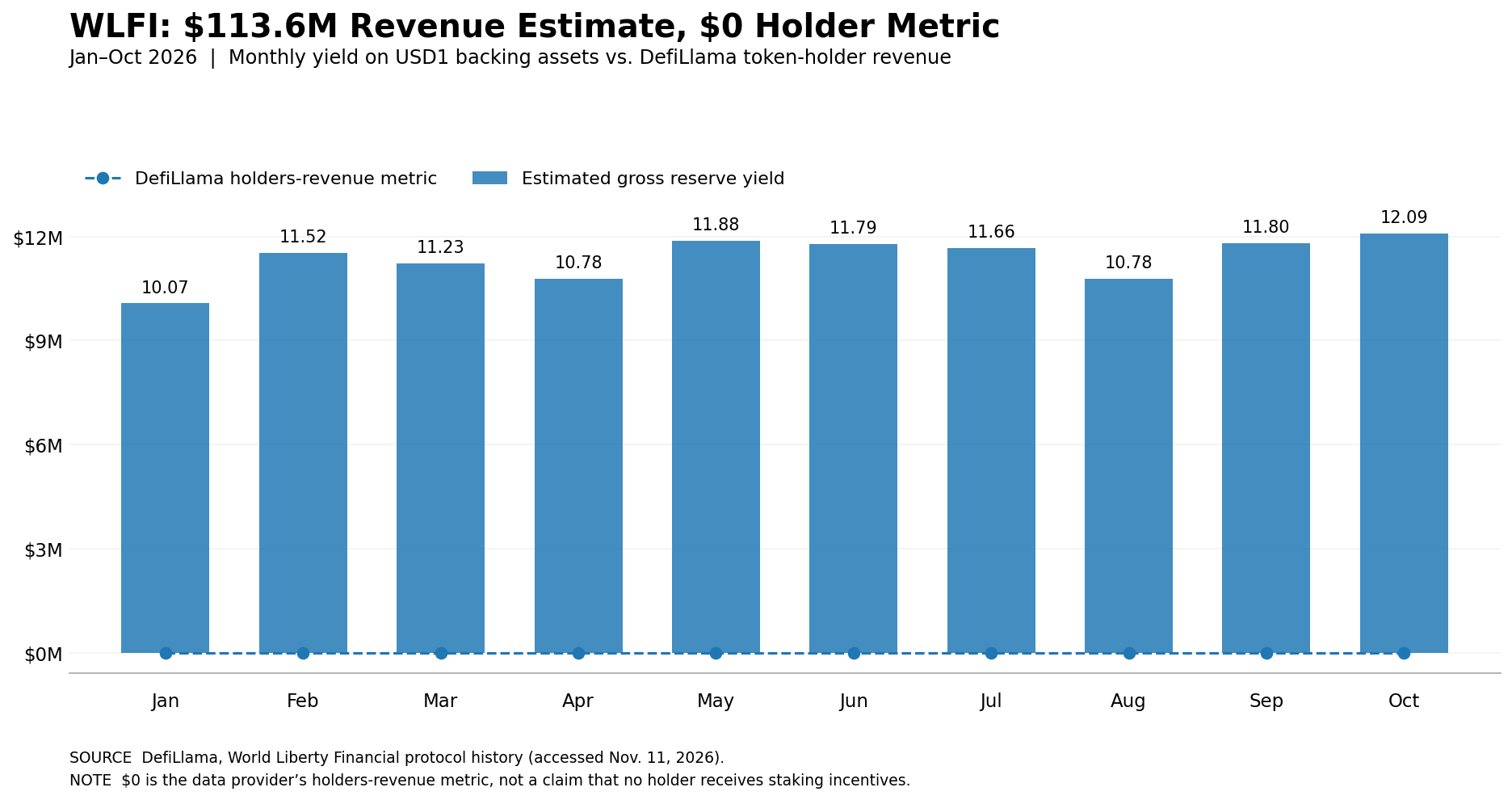
That doesn’t mean World Liberty never rewarded token holders. The metric measures a specific category of economic distribution and doesn’t capture every possible incentive, buyback, or promotional arrangement.
But it does show why comparing protocol revenue with token market capitalization can be misleading.
A business generating $113.6 million in estimated reserve yield is one thing.
A token with an enforceable right to receive part of that money is something else.
And WLFI’s own documentation makes the distinction explicit.
WLFI Holders Don’t Own the Business Behind the Revenue
World Liberty Financial has never needed to promise WLFI holders company profits to give them a reason to participate.
The token’s stated purpose is governance.
Under the project’s DefiLlama’s World Liberty Financial dashboard, holders can submit proposals, participate in discussions, and vote on matters affecting the protocol.
But those powers come with limitations.
A governance proposal requires at least one billion WLFI tokens participating and approval from a majority of votes cast.
World Liberty Financial LLC also screens proposals before formal voting, and approval doesn’t guarantee implementation.
The documents explicitly separate participation in governance from ownership or control over the business.
In practical terms, holding WLFI isn’t equivalent to owning shares in the company operating the ecosystem.
That distinction becomes even more important when looking at who actually has contractual economic interests.
World Liberty Financial’s corporate disclosures identify WLF Holdco LLC as the holder of rights to net protocol revenue under its agreements with the operating company.
They also disclose that DT Marks DEFI LLC, affiliated with Donald Trump and certain family members, owns roughly 38% of WLF Holdco.
Separately, DT Marks DEFI LLC is entitled to 75% of WLFI token-sale proceeds after agreed deductions under a service agreement.
Those percentages shouldn’t be confused.
The 75% provision concerns token-sale proceeds, not an automatic claim on 75% of USD1 reserve yield.
Another affiliated entity, DT Marks SC LLC, has an indirect economic interest through roughly 38% beneficial ownership of an affiliate entitled to interest generated by USD1 reserves.
These disclosures don’t establish the actual dollar amounts paid to each entity during November.
They do establish something important about the economic structure.
The companies and their contractual partners have identifiable rights connected to business revenue.
Ordinary WLFI ownership does not provide the same claim.
This isn’t necessarily unusual in crypto. Governance tokens frequently sit beside operating companies, foundations, or other entities that control financial resources.
But it changes how investors should interpret a revenue chart.
World Liberty Financial can become more profitable without creating an equivalent, enforceable claim for everyone holding WLFI.
The buyback program is intended to provide a possible bridge between those two realities.
How much weight can that bridge carry?
The $10 Million Buyback Question
On November 6, World Liberty Financial announced a new WLFI buyback initiative, saying the initial allocation could include fees associated with USD1 reserves and other funding sources.
The company described the purchases as a way to encourage long-term governance participation.
On November 9, it identified Aster as the execution venue and disclosed a public BNB Chain wallet associated with the program.
Reports circulating around the announcement described a transfer of 10 million USD1 to Aster.
That figure is useful for examining the economics, but it requires a crucial qualification: funding deposited onto a trading venue isn’t the same as completed WLFI purchases.
Ravel could not independently reconstruct the full execution history from the designated wallet and Aster trading records as of November 11. The total quantity purchased and its ultimate disposition, therefore, remain unverified in this analysis.
Still, consider a hypothetical recurring buyback budget of $10 million per month.
Against DefiLlama’s $10.98 million trailing-30-day revenue estimate, that would consume the equivalent of 91.1% of gross reserve yield.
And that’s before accounting for partner payments, operating costs, and other obligations.
World Liberty itself acknowledged in its November 9 statement that a substantial portion of USD1 gross revenue goes to partners and service providers.
The company also stated that buyback timing, size, and execution depend on available resources and that the program may be modified or discontinued.
In other words, there is no disclosed formula committing a fixed percentage of USD1 revenue to monthly token purchases.
A $10 million monthly buyback would amount to $120 million annually if sustained for 12 months.
That’s more than the $113.6 million in estimated gross reserve yield recorded for the first ten months of 2026, although those are different measurement periods.
Neither comparison proves the company cannot afford such purchases. Buybacks may be funded from treasury resources, other business activities, or capital accumulated during earlier periods.
But they reveal why projecting a recurring $10 million purchase budget from the announced program would be premature.
The company’s ability to buy tokens and its obligation to keep doing so are two very different things.
And there’s another distinction worth making.
Buying WLFI doesn’t automatically reduce its total supply.
Buying Tokens Is Not the Same as Burning Them
World Liberty has discussed token repurchases before.
In September 2025, the team introduced a proposal to use 100% of fees generated by protocol-owned liquidity to purchase WLFI and permanently burn the acquired tokens.
That proposal established a specific relationship between one revenue source and token supply reduction.
Fees from the project’s own liquidity positions would be used to purchase WLFI on the open market, with the acquired tokens sent to a burn address.
The mechanism didn’t cover every dollar generated by the broader business.
The November 2026 initiative has a different structure.
It potentially draws on USD1-related economics and other resources, with the company determining the timing and size of purchases.
The November announcement doesn’t establish an equivalent fixed spending percentage or an automatic burn requirement for every token acquired.
Consider the economics at WLFI’s November 11 reference price of roughly $0.046.
A hypothetical $10 million purchase at that price would acquire around 217 million WLFI, before fees and market impact.
Against the roughly 31.78 billion tokens circulating at the time, that’s equivalent to about 0.68% of the circulating supply.
But the percentage isn’t automatically a reduction in supply.
Repurchased tokens can be held in treasury, burned, or potentially redeployed depending on the program’s terms and subsequent decisions.
Only permanent destruction creates an equivalent reduction in total token supply.
Nor would buying 0.68% of circulating tokens guarantee a 0.68% increase in price or any specific price increase at all.
The purchases would interact with actual market liquidity, seller behavior, and broader trading conditions.
As Ravel previously found in its investigations of Maple Finance’s SYRUP buybacks and Lido’s automated buyback system, the existence of a repurchase program doesn’t settle how much lasting value reaches token holders.
What matters is the spending rule, available funding, execution, and what happens to the tokens afterward.
WLFI still leaves several of those variables open.
Staking Rewards Complicate the Zero-Revenue Story
There is an important counterargument to the idea that WLFI holders receive nothing from the ecosystem.
World Liberty has introduced a governance staking program that offers qualifying participants potential rewards in USD1.
According to the official staking framework, eligible holders must lock unlocked WLFI for at least 180 days and actively vote on governance proposals to claim rewards.
The reward rate is variable.
Its funding comes from a shared pool, and the promotional program can change or end.
That means some WLFI holders can potentially receive an economic benefit without having contractual ownership of the business.
The two aren’t contradictory.
Staking incentives reward participation under specific conditions. They are not dividends automatically distributed to everyone who holds WLFI.
The September governance proposal made the distinction particularly clear: the program does not grant participants ownership interests or economic rights relating to World Liberty Financial.
It’s a meaningful benefit for eligible users who participate.
But it isn’t the same as a permanent mechanism requiring the company to distribute a predetermined share of USD1’s revenue.
That leaves WLFI with several possible sources of value: governance participation, conditional staking incentives, discretionary token purchases, and the market’s expectations about future ecosystem growth.
None should be confused with an enforceable claim on corporate profit.
A Strong Business Doesn’t Automatically Mean a Stronger Token
There is a reasonable bullish interpretation of World Liberty’s strategy.
USD1 has grown into a multibillion-dollar stablecoin, with substantial reserves and measurable yield-generating assets.
The company has an established commercial operation rather than relying entirely on speculative token activity.
Its new buyback initiative could create additional WLFI demand, and a public wallet offers a starting point for independent transaction monitoring.
Governance staking also provides a reason for some holders to lock tokens and remain engaged.
Those developments matter.
The decline in USD1 circulation does not mean the stablecoin business has failed. Its supply could expand again, interest income may remain substantial, and new partnerships could support further adoption.
Likewise, discretionary buybacks aren’t automatically ineffective. They may allow management to adjust spending when market conditions or available resources change.
But that flexibility comes at the expense of predictability.
There is no disclosed rule ensuring that every additional dollar of USD1 revenue creates a proportional increase in WLFI buybacks.
There is no automatic right for passive token holders to receive the company’s profits.
And there is no verified basis, from the disclosures examined here, for treating the reported $10 million Aster funding as a recurring monthly commitment.
The numbers are meaningful precisely because they expose those limits.
At September’s peak reporting snapshot, USD1 had $4.42 billion in circulation.
By November 11, it had about $3.35 billion.
DefiLlama estimated $113.6 million in reserve-related revenue from January through October, yet recorded zero in its token-holder revenue category.
Meanwhile, World Liberty is offering a new way for some of its business economics to support WLFI, without committing to a fixed schedule or revenue-sharing formula.
The distinction isn’t whether World Liberty Financial can make money.
The evidence suggests its stablecoin operation already does.
The question is how much of that success is structurally connected to the token investors can actually buy.
For now, USD1 has the revenue engine. WLFI has a discretionary connection to it.
And until buyback spending becomes measurable and repeatable, those are not the same thing.