
On Friday, October 23, crypto traders began circulating a simple message: stop trading on Pump.fun.
The hashtag #BOYCOTTPUMPFUN spread across X, fueled by frustration over a long-awaited PUMP airdrop, an increasingly contentious influencer partnership, and a growing belief that the memecoin machine was making plenty of money without giving ordinary traders much in return.
Some wanted accountability. Others wanted to hit the platform where it hurt most: its revenue.
But on that very same day, Pump.fun announced something that seemed almost designed to keep the trading floor buzzing.
A $2.5 million competition.
Not an airdrop, and not a distribution to every loyal user. The money would go to three teams capable of generating the highest trading profits over two weeks.
The timing created an unusual standoff. One part of the community wanted traders to stop feeding Pump.fun’s business. The platform was offering them another reason to keep trading.
And beneath that confrontation sits a less obvious detail.
Six days before the boycott began, Pump.fun had introduced a new fee on trades made through its web and mobile applications.
That matters because the most obvious way to measure a boycott—watching how much money a platform makes—had just become more complicated.
So Ravel examined Pump.fun’s published fee schedule, daily trading data, and competition rules to investigate a deceptively simple question.
Can a community boycott weaken a crypto platform that continues collecting fees from the people still playing?
The Boycott Arrived After Pump.fun Changed Its Fees
The anger had a cause.
On July 9, 2025, Pump.fun announced its PUMP token launch, accompanied by three words that would prove remarkably durable: “airdrop coming soon.”
By October 27, 2026, 475 days had passed.
The original statement offered no firm distribution deadline. That distinction matters; an unspecified timeline is not the same as a contractual promise broken on a particular date.
Still, the absence of a widely anticipated airdrop remained a source of frustration.
Then came the Kimchi controversy. A collaboration involving the crypto influencer and a disputed token launch generated accusations and confusion, with deleted posts and questions surrounding how the promotion had been handled.
Those allegations do not establish any findings of misconduct. But they contributed to the frustration that preceded the boycott.
On October 23, trader RonPull posted the boycott hashtag. Two days later, another trader, Jack Duval, publicly promoted an effort to reduce Pump.fun’s revenue until the airdrop issue was addressed.
The resulting campaign posed a straightforward economic threat. If enough traders stopped using Pump.fun, the platform would collect fewer transaction fees.
That sounds logical.
But there is a catch.
According to Pump.fun’s official fee schedule, updated October 17, trades executed through its web and mobile applications now incur an additional platform fee of 0.45%, or 0.40% when a referral code applies.
The charge sits on top of existing trading fees.
On the bonding curve, a standard transaction already carries a 1.25% fee, split between a 0.95% protocol fee and a 0.30% creator fee.
Add the new application charge, and a qualifying trade without a referral code costs 1.70%, excluding network and other applicable costs.
Consider a $1,000 trade.
The existing bonding-curve fee would amount to $12.50. The additional application fee adds $4.50, bringing the combined charge to $17.
Under that specific fee structure, the platform’s protocol and application portions total $14, while the remaining $3 goes to the creator.
That’s a meaningful distinction when evaluating who benefits from trading activity.
The additional fee does not apply to transactions placed through Pump.fun Terminal or third-party interfaces, which may impose their own charges. And after a token graduates to PumpSwap, a different fee schedule can apply.
So the 1.70% figure is not a universal tax on every Pump.fun transaction.
Nevertheless, it introduces another revenue stream tied to trading through Pump.fun’s own applications.
The timing does not prove the fee change was connected to the boycott. It was introduced before the protest gathered momentum.
But it does change how the business should be measured.
A platform can experience lower transaction activity while collecting more revenue per qualifying trade. Conversely, falling fees could reflect weaker market activity, changes in transaction sizes, or shifts between trading interfaces rather than a successful boycott.
Revenue alone cannot separate those possibilities.
And the actual trading data makes that distinction even more important.
The Fees Fell. Then Came a Rebound
Pump.fun’s daily trading fees reveal a noticeable deterioration as the boycott gained attention.
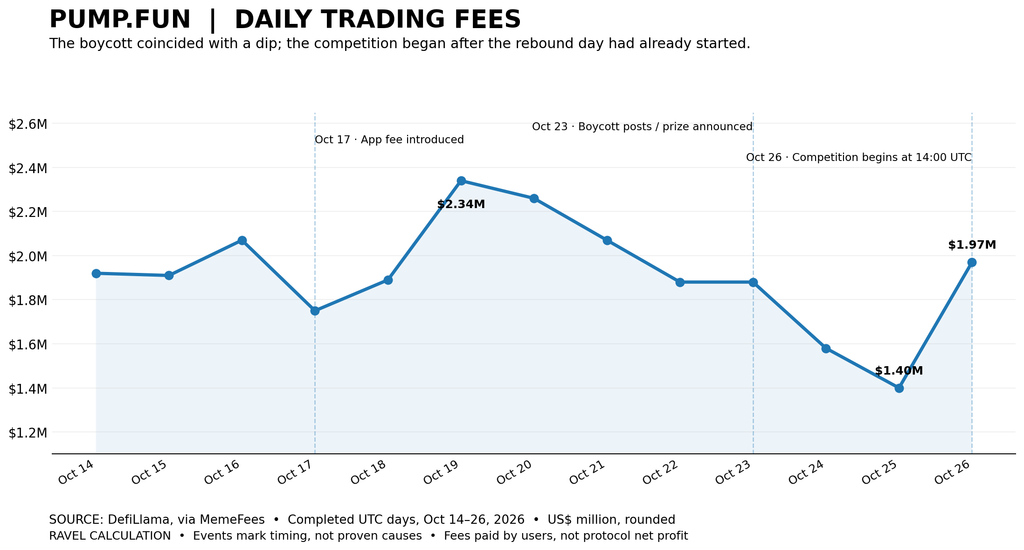
According to DefiLlama data compiled by MemeFees, the platform generated about $2.34 million in trading fees on October 19.
By October 23, that figure had fallen to $1.88 million.
On October 24, it declined to $1.58 million. A day later, fees reached $1.40 million.
From the October 19 high to October 25, that’s a decline of roughly 40.2%.
It would make an appealing headline to declare that the boycott had knocked 40% off Pump.fun’s fees.
It would also be an unjustified conclusion.
The decline began before the boycott, and the two dates fall on different days of the week. Crypto trading activity fluctuates considerably, particularly across the memecoin market.
A better starting point is to compare equivalent weekdays.
Ravel calculated the total fees collected between Saturday, October 17, and Monday, October 19, then compared them with Saturday, October 24, through Monday, October 26.
The first period generated about $5.98 million.
The second generated $4.95 million.
That’s a 17.2% decline across matching three-day weekday windows.
Both periods followed the introduction of the new application fee, reducing one obvious pricing inconsistency in the comparison.
But this still isn’t a controlled experiment. The first period includes the days immediately after the fee change, while the second includes the first day of the trading competition.
More importantly, the figures don’t tell us how many traders deliberately stopped using the platform because of the boycott.
There is another reason to resist a quick verdict.
Pump.fun wasn’t the only launchpad experiencing changes in trading activity.
During the same Saturday-to-Monday comparison, Raydium LaunchLab’s reported fees rose from roughly $134,100 to $276,000, an increase of 105.8%.
Meanwhile, LetsBONK.fun, which operates using Raydium LaunchLab infrastructure, saw its reported fees increase from about $116,900 to $228,400.
Those two datasets overlap and cannot be added together as independent activity.
Still, their direction is worth noticing.
Pump.fun’s fees were falling across the matched periods while activity measured through competing launchpad infrastructure was growing.
Could some dissatisfied traders have moved elsewhere?
Possibly.
But that would require wallet-level evidence tracing users who previously traded on Pump.fun and subsequently migrated their activity to another platform.
These aggregate fee figures do not establish such a migration. Changes in popular tokens, transaction sizes, and the broader market could explain part of the divergence.
Then came October 26.
Pump.fun’s daily trading fees rebounded to $1.97 million, roughly 40.7% above the previous day’s figure.
Its active wallet addresses also increased from 106,965 to 143,300, a rise of about 34%.
Yet the number of recorded trading transactions moved in the opposite direction, slipping from approximately 3.77 million to 3.47 million.
More active addresses, fewer transactions, and higher fees.
Not exactly a clean narrative of collapsing activity—or an uncomplicated recovery.
There is also a timing problem for anyone tempted to credit the competition with the rebound.
The contest officially began at 14:00 UTC on October 26, meaning most of that UTC day had already passed.
Without hourly data separating activity before and after the launch, the full-day increase cannot be attributed to the competition.
What the numbers establish is narrower, but more defensible: Pump.fun experienced measurable weakness during the boycott period, followed by a rebound in daily fees, while its activity indicators did not move uniformly.
Whether the protest caused the weakness remains unproven.
A $2.5 Million Prize, but Who Gets the Money?
The competition offers another way to examine the economic relationship between Pump.fun and its users.
On October 23, the platform announced its $2.5 million Squads competition, scheduled to run from October 26 through November 9.
The largest prize, $1.5 million, goes to the highest-performing squad.
Second place receives $750,000, while third place collects $250,000.
Each squad can include up to 20 members.
That means a maximum of 60 eligible traders across the three winning squads could share the entire prize pool, assuming every winning squad is full and every member has positive qualifying performance.
The number of actual recipients could be lower.
According to the platform’s competition terms, rewards are distributed proportionally based on each eligible participant’s contribution to their squad’s positive score. Members whose performance is zero or negative receive nothing.
There is an additional wrinkle.
The competition uses both realized and unrealized profit and loss when calculating rankings.
Unrealized profits can disappear before a position is closed. Therefore, a favorable competition score is not necessarily equivalent to cash already withdrawn from successful trades.
Participants also remain subject to trading costs, while Pump.fun reserves authority to disqualify manipulative activity.
This is a trading competition, not a broad-based distribution of ownership or revenue.
And that matters because much of the boycott revolves around a different question: how should the economic benefits generated by Pump.fun be shared?
The distinction becomes clearer when examining the platform’s finances.
DefiLlama’s Pump.fun dashboard reported around $13.04 million in trading fees over the latest seven-day period, with approximately $9.39 million classified as protocol revenue.
It also recorded about $5.50 million in PUMP buybacks under its holders-revenue category.
These are different financial measures.
Trading fees include money collected from users and distributed among protocol-related and other eligible recipients. Protocol revenue represents the portion attributed to Pump.fun under DefiLlama’s methodology, not audited net profit.
Buybacks involve purchases of PUMP on the market; they are not equivalent to direct cash dividends received by every tokenholder.
Using the $9.39 million weekly revenue figure, Ravel calculates that the entire $2.5 million competition prize is equivalent to 26.6% of one week’s reported protocol revenue.
That doesn’t mean the prize pool is funded directly from that particular week, or that the competition will generate enough incremental revenue to cover its cost.
It simply puts the size of the promotion into context.
Pump.fun is offering a substantial incentive while operating a business that continues generating millions in weekly revenue.
But the distribution mechanisms differ.
Creators can earn designated trading fees. Tokenholders may benefit indirectly from PUMP buybacks. A limited number of profitable traders can win competition prizes. The platform itself retains protocol revenue and certain application fees.
None of those mechanisms is inherently illegitimate.
They do, however, serve different constituencies.
And a trader who has been waiting for an airdrop since 2025 may not view the possibility of winning a highly competitive trading contest as an equivalent benefit.
There is a final complication.
Even traders competing for the prize continue generating transaction fees whenever they execute qualifying trades.
Some may win life-changing amounts. Others may finish with losses, pay trading costs, and receive nothing from the prize pool.
For Pump.fun, the structure creates a clear incentive for participation. Whether the resulting additional business activity is sufficient to justify the prize remains to be seen.
That isn’t proof the competition was created to undermine the boycott. The public evidence does not establish Pump.fun’s internal motivation.
But the two initiatives undeniably pull trader behavior in opposite directions.
The boycott asks people to stop trading.
The competition rewards selected people for trading successfully.
And both revolve around the same underlying activity that makes Pump.fun valuable.
This is where the broader narrative becomes interesting.
The crypto industry often frames community participation as a form of collective ownership. Yet participating in a platform’s economy, holding its token, and exercising meaningful influence over how revenue is distributed are three very different things.
Pump.fun’s users can generate substantial economic activity without necessarily having contractual authority over the company’s business decisions.
Likewise, a profitable platform can maintain strong revenue while facing growing dissatisfaction from some of its most vocal users.
The boycott may eventually reduce trading activity. The competition may attract new participants. Some traders might move to competing platforms, while others simply wait for the next meme coin worth chasing.
The existing data cannot tell us which force will prevail.
What it does show is that social media anger and economic leverage are not automatically the same thing.
For this boycott to become a measurable business challenge, discontent would need to translate into sustained declines in comparable trading activity and revenue—not merely a few weak days in a volatile market.
Until then, the gap between the narrative and the numbers remains unresolved.
Pump.fun’s community wants to know what it gets back from the machine. The machine, meanwhile, keeps collecting fees whenever someone decides to play.