
There’s something undeniably appealing about a token burn.
Fewer coins, less supply, and, at least in theory, a better chance for the remaining tokens to become more valuable. It’s one of crypto’s favorite investment narratives because the math looks so straightforward.
Osmosis is now putting that theory to the test.
After governance voted to end new OSMO issuance, the Cosmos-based decentralized exchange unveiled another proposal on October 27: permanently destroy 55.5 million OSMO, equivalent to roughly 7% of its reported token supply.
At prevailing prices cited in the proposal, those tokens carried a notional value of about $3.2 million.
The plan would bring cumulative OSMO burns to what the proposal describes as more than 100 million tokens, another milestone for a project reshaping its economics around scarcity and protocol-generated revenue.
It’s a compelling story. A former inflationary token becomes deflationary, staking rewards shift toward real trading fees, and tens of millions of tokens disappear from the supply.
But the most important detail sits inside the proposal itself.
The 55.5 million OSMO earmarked for destruction are not currently circulating in the market.
They already belong to Osmosis’s community treasury.
And that changes what the proposed burn actually means for investors.
The 7% Burn Has a Catch: The Tokens Were Already Out of Circulation
On October 27, Osmosis governance contributor Johnny Wyles published a proposal to burn 55.5 million OSMO from the community pool.
The transaction would send the tokens to a designated null address, effectively making them permanently inaccessible.
The target date for the on-chain proposal is October 30. As of October 28, the action remains proposed, not a completed burn.
According to the governance discussion, the community pool holds around 119.3 million OSMO. Destroying 55.5 million would leave approximately 63.8 million in that treasury.
Using the proposal’s reported total supply of roughly 794 million OSMO, Ravel calculates that the burn would remove 6.99% of the total supply.
That percentage is mathematically meaningful.
But it doesn’t mean 6.99% of the tokens available for trading would suddenly disappear from exchange liquidity.
The proposal explicitly explains that OSMO held in the community pool is already outside active circulation.
This arrangement has a history.
Earlier governance decisions redirected much of Osmosis’s newly issued OSMO into the community treasury rather than releasing it as staking rewards or other circulating distributions.
The practice became known as a ‘soft burn.’
The tokens existed, but they weren’t actively circulating. Governance retained the ability to release them through future proposals.
That final distinction is crucial.
A soft burn removes tokens from immediate circulation while preserving the possibility of future spending. A hard burn eliminates that possibility altogether.
So Osmosis isn’t pretending to destroy something that doesn’t exist. It is converting a reversible restriction into permanent removal.
For investors, the economic benefit is real, but different from the conventional supply-shock narrative.
The burn reduces future potential dilution. It doesn’t directly purchase OSMO from traders, absorb existing sell orders, or immediately remove 55.5 million tokens from the market.
Even the proposal acknowledges that the tokens’ estimated $3.2 million value is notional because market liquidity could not support selling the entire amount at the quoted spot price.
In other words, multiplying the treasury balance by the market price doesn’t establish how much cash that treasury could actually raise.
There’s another revealing calculation.
The proposed burn represents approximately 46.5% of the community pool’s OSMO holdings.
That still leaves 53.5% of those holdings available for future governance decisions.
And the community pool isn’t the only reservoir of OSMO outside ordinary market circulation.
An earlier governance proposal to end inflationary emissions, which subsequently passed as Proposal 1053, explains that approximately 51.9 million OSMO remain in a developer vesting module.
Those tokens were minted at genesis. Their scheduled release has been paused, and any future distribution would require a separate governance decision.
Combine the two categories after the proposed burn, and the picture becomes clearer.
The community pool would retain approximately 63.8 million OSMO, while the developer vesting module would retain another 51.9 million.
That’s 115.7 million OSMO remaining across two restricted reserves, calculated by Ravel.
The figure isn’t a forecast of future selling pressure. The two reserves have different purposes and release mechanisms, and there is no evidence that their entire balances will enter the market.
But it shows why the headline 7% reduction doesn’t capture the full supply picture.
Osmosis is eliminating a substantial portion of its potential future overhang, not erasing all of it.
And the distinction between tokens that exist, tokens that circulate, and tokens that investors can actually sell becomes even more important when examining what is happening to the business behind OSMO.
The Supply Is Shrinking. The Business Has Been Shrinking Too
The most revealing part of Osmosis’s tokenomics overhaul may have little to do with the burn itself.
It concerns the money the exchange actually earns.
Osmosis operates a decentralized trading platform, meaning its underlying economic activity depends on users exchanging assets and paying fees.
Some of those fees support token burns. Others help compensate participants who secure the network.
The entire model works better when people trade more.
And that’s where the recent numbers become uncomfortable.
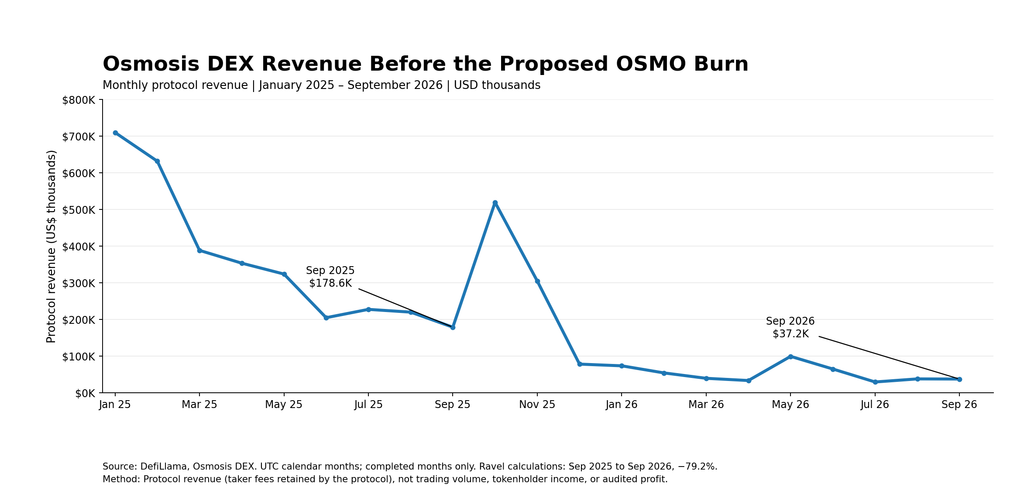
According to DefiLlama’s historical data for Osmosis DEX, the protocol generated $178,629 in revenue during September 2025.
In September 2026, the figure was $37,185.
That’s a 79.2% year-over-year decline, based on Ravel’s calculation.
This isn’t simply a comparison between an unusually active trading day and a quiet weekend. Both figures cover complete calendar months, twelve months apart.
Osmosis’s total value locked shows a similar pattern, although it measures something different.
TVL fell from approximately $36.58 million at the end of September 2025 to $11.16 million at the end of September 2026.
That’s a decline of roughly 69.5%.
TVL is affected by asset prices as well as deposits and withdrawals, so it cannot independently establish how many users abandoned the protocol.
Revenue, meanwhile, depends on trading activity and the fees the protocol retains. It isn’t interchangeable with net profit or total exchange volume.
Still, the combination points toward a business operating at a much smaller economic scale than a year earlier.
The longer series adds an important wrinkle.
Osmosis did experience a temporary revenue surge in October 2025, when monthly revenue reached about $519,101.
But that recovery didn’t last.
By December, revenue was down to $77,907. Throughout much of 2026, monthly revenue remained well below $100,000.
There were occasional improvements, including May’s $99,051, but no sustained return to the levels seen earlier in 2025.
None of this proves that OSMO is overpriced, nor does it establish where its market price should trade.
A token’s valuation also reflects expectations about future adoption, governance rights, staking economics, liquidity, and the broader crypto market.
But the data raises an uncomfortable question for a project promoting supply-driven improvements.
If fewer OSMO tokens exist, but the exchange earns substantially less money than before, what exactly supports the investment case beyond scarcity?
There is a credible bullish response.
By stopping new issuance, Osmosis reduces the amount of newly created OSMO that might otherwise dilute existing holders. If trading activity recovers, fee-funded buybacks and burns could become more economically meaningful because new issuance no longer offsets them.
That would provide future growth a clearer route to benefiting the token economy.
But the other side is just as important.
If trading activity remains weak, reducing token supply cannot manufacture additional protocol revenue.
Scarcity changes the denominator.
Demand still determines whether the underlying economics improve.
Staking Rewards Now Depend on the Economy Osmosis Can Actually Generate
The governance changes become more consequential when viewed together.
Osmosis hasn’t simply proposed destroying treasury tokens. It has also changed how new supply and staking rewards work.
Before inflation ended, the mint mechanism was configured to distribute around 121,766 OSMO per day.
However, not all of those tokens entered circulation.
Roughly 67% went to the community pool, 25% was associated with developer vesting releases, and only 8% went directly to staking rewards.
That means the headline issuance figure overstated the amount of newly created OSMO immediately reaching ordinary holders.
Even the developer allocation requires nuance: the governance discussion states that the released tokens had remained untouched in their designated address since December 2025.
Stopping issuance therefore doesn’t necessarily eliminate 121,766 OSMO of daily selling pressure.
It stops the minting process, pauses the associated developer release, and removes the remaining issuance-based staking subsidy.
What replaces that subsidy is arguably more interesting than the headline burn.
Under Proposal 1052’s fee redistribution framework, the portion of non-OSMO taker fees allocated to staking rewards increased from 22.5% to 47.5%.
The allocation to the community pool fell from 25% to zero, while the burn allocation remained at 52.5%.
That changes the economic incentives significantly.
Instead of using newly issued tokens to supplement staking yields, Osmosis is directing more of its existing fee revenue toward validators and delegators.
The proposal estimated that the additional allocation could raise staking APR by approximately 1.7 percentage points under the trading volumes and token price prevailing at the time.
Meanwhile, ending inflation removes approximately 2 percentage points of issuance-funded APR.
These estimates aren’t guaranteed yields. Trading fees fluctuate, token prices change, and staking returns depend on participation and other network conditions.
But the broader shift is clear.
OSMO staking is becoming more closely tied to productive economic activity rather than token creation.
For long-term investors, that is a meaningful structural change.
It creates a stronger connection between how much the network is used and how much economic value can be distributed to those helping secure it.
However, there is a trade-off.
The same change also means weaker trading activity can translate into weaker fee-funded rewards.
And directing more fees toward stakers means less from that revenue stream is left for the community treasury.
Osmosis argues that this is manageable because the DAO has already accumulated reserves outside OSMO.
The governance discussion identified around $1.8 million in non-OSMO reserve assets after accounting for funds designated for restoring Alloyed BTC backing, with roughly $1 million deployed as liquidity.
These assets provide some financial flexibility, although assets committed to liquidity or other purposes shouldn’t be treated as unrestricted cash.
That consideration surfaced again in the discussion surrounding the new burn proposal.
A community member questioned whether the network would retain enough resources to support validators.
The response pointed to non-OSMO reserves, increased fee revenue directed toward staking, and possible further parameter changes to improve validator sustainability.
It’s a reasonable argument. Osmosis may be choosing to replace a token-heavy treasury model with a leaner system funded by actual economic activity.
But that strategy creates a higher burden of proof.
A smaller treasury and zero inflation can make tokenomics more disciplined. They also reduce some flexibility to fund future development, incentives, and network support using native tokens.
Whether that trade-off proves beneficial depends on what Osmosis can build with the resources it retains.
For investors, the next milestones are therefore more revealing than the symbolic total of tokens burned.
First, the proposed 55.5 million OSMO destruction must receive the necessary governance approval and be executed. The October 30 target remains a scheduled event, not an accomplished transaction.
Second, the adjusted staking rewards need to demonstrate that fee-generated income can sustainably support participation and network security.
And third, Osmosis needs to show that its trading economy can grow.
That final test is the hardest.
Unlike a burn transaction, which can be verified through a single on-chain event, economic recovery requires sustained activity across weeks and months.
It means attracting liquidity, generating meaningful trading fees, and persuading users to keep trading on Osmosis rather than somewhere else.
A deflationary token model could help existing holders capture more value if those things happen.
It cannot guarantee that they will.
Ravel’s supply calculations use the rounded balances disclosed in Osmosis’s governance proposals, while the historical revenue comparison uses DefiLlama’s protocol-level methodology. Neither represents an independently audited valuation of OSMO, and the planned treasury burn has not been treated as completed.
The proposed destruction of 55.5 million OSMO is therefore meaningful and not the immediate market supply shock its headline percentage might suggest.
It removes a genuine future issuance option. It also leaves substantial restricted reserves in place.
More importantly, it arrives while the protocol’s measured revenue remains far below its level a year earlier.
That is the central tension in Osmosis’s new investment narrative.
Burning tokens can make OSMO scarcer. Only a stronger economy can make that scarcity matter.