
For a brief moment in 2025, Plasma looked like it had figured out something most new blockchains could only dream about: how to attract billions of dollars before the ecosystem had even found its footing.
The stablecoin-focused Layer 1 had serious financial backing. Founders Fund, the venture capital firm associated with Peter Thiel, was an investor. So were Framework Ventures and Bitfinex. Its public token sale attracted $373 million in commitments against a $50 million target, leaving thousands of prospective investors competing for a relatively small allocation.
Then came September 25.
Plasma launched its mainnet, bringing stablecoin liquidity and more than 100 DeFi partners into an ecosystem built around a simple proposition: moving digital dollars shouldn’t require paying traditional blockchain transaction fees.
Within 48 hours, deposits into Aave on Plasma had surged to billions. By mid-October, the market had reportedly peaked at $6.6 billion.
The excitement was understandable. Here was a blockchain purpose-built for stablecoins, attracting institutional attention and extraordinary amounts of capital almost immediately.
And then the excitement faded.
A year later, Aave’s Plasma market holds less than half a billion dollars. XPL, the network’s native token, trades around $0.074, more than 95% below its September 2025 all-time high.
The obvious story would be that another heavily funded blockchain failed to live up to its launch.
Except Plasma hasn’t disappeared.
Its network still holds more than $1 billion in stablecoins. Its payment card is processing millions of dollars in observed monthly spending. And a new collaboration with Stripe suggests the company is increasingly focused on financial products people might actually use.
That leaves a more interesting question.
Did Plasma lose its early investors, or did it simply outgrow the speculative business that first made it famous?
Ravel examined Aave’s liquidity history, Plasma’s token distribution, independent card settlement data, and the economics connecting network activity to XPL.
What emerged was a project with a functioning product business—and a token whose investment case remains considerably harder to prove.
The $6.6 Billion Launch That Couldn’t Keep Its Liquidity
Plasma’s opening act was extraordinary, even by crypto standards.
Its September 2025 mainnet announcement described a network launching with $2 billion in stablecoins and partnerships spanning Aave, Ethena, Fluid, Euler, and other major DeFi protocols.
The company had already built considerable momentum through a deposit campaign and token sale.
But the biggest demonstration came from Aave.
According to Aave’s official 2025 review, the Plasma deployment attracted $1.3 billion in deposits during its first hour. Within 48 hours, the amount had reached $6.6 billion, making it Aave’s fastest-growing market at the time.
That level of demand wasn’t entirely spontaneous.
Plasma subsequently disclosed an initial commitment of $10 million in XPL incentives supporting its Aave deployment. The company also promoted an early capital-attraction efficiency ratio of $160 in TVL for every dollar of incentives during the first eight weeks.
That sounds impressive, and it was.
But incentives are excellent at answering one question: how much money can a protocol persuade people to bring in?
They are considerably less reliable at answering another: how much of that money will stay when the opportunity changes?
By October 28, 2026, DefiLlama’s Aave V3 dashboard showed roughly $462 million in TVL on Plasma.
Compare that with the reported $6.6 billion launch-era peak, and the decline is about 93%, based on Ravel’s calculation.
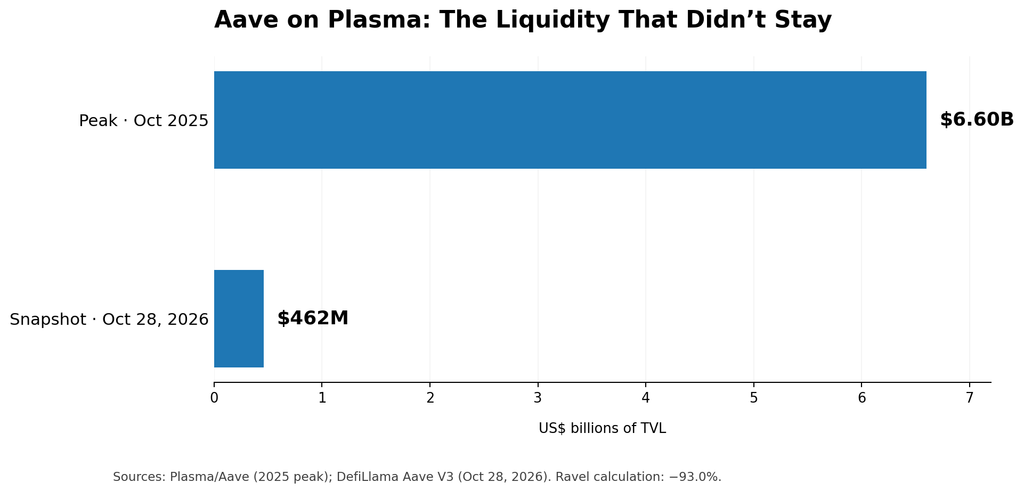
That doesn’t mean exactly $6.1 billion was withdrawn from the Plasma blockchain.
Some capital could have moved to other applications. Some positions may have been unwound or used to repay loans. Changes in asset values also influence TVL, and the historical peak comes from Aave and Plasma’s disclosures rather than a reconstructed DefiLlama series using identical accounting throughout.
As Ravel previously explored in its investigation into what TVL actually measures, deposits, economic ownership, and productive capital aren’t interchangeable concepts.
The useful conclusion is narrower.
Plasma demonstrated an exceptional ability to attract liquidity during a period when financial incentives and launch expectations were particularly strong.
It has not demonstrated that the same level of capital would remain permanently committed to Aave.
Yet the broader network is hardly empty.
On October 28, DefiLlama reported about $541 million in DeFi TVL across Plasma and around $1.33 billion in stablecoin supply.
The latter figure is particularly important.
Stablecoin supply is not the same thing as DeFi TVL. It measures the outstanding value of tracked stablecoins on the network, including funds that may not be deposited into lending protocols.
It also doesn’t tell us how often those stablecoins are used for actual payments.
A billion dollars sitting in wallets can look remarkably similar to a billion dollars actively circulating through businesses—until someone tries to measure the transactions.
Plasma’s own dashboard uses a broader asset presentation that includes certain yield-bearing tokens, producing a higher figure than DefiLlama’s conventional stablecoin metric. Those totals should not be treated as equivalent without reconciling the assets included.
Still, the available numbers establish that meaningful capital remains on Plasma.
The harder question is what that capital is doing.
And the most interesting answer now comes from a business that wasn’t the centerpiece of Plasma’s 2025 DeFi frenzy.
Plasma One Is Growing. But the User Data Tells a Stranger Story
In September 2026, Plasma One recorded $25.6 million in observed card spending.
That was up 28.9% from August’s $19.9 million.
For a blockchain that initially attracted attention through liquidity incentives and token speculation, this is a meaningful change in the story.
Instead of asking how many billions can be deposited into a lending protocol, Plasma is beginning to demonstrate how much money users can spend through a financial product.
The figures come from SpendNode’s September 2026 crypto-card report, which measures identifiable on-chain settlement activity across eleven card programs.
Plasma One wasn’t the largest participant. Ether.fi recorded $128.8 million, while KAST generated $113.8 million.
But among programs processing more than $1 million during the month, Plasma One recorded the fastest percentage growth.
That is genuine evidence of increasing measured payment activity.
There is, however, a detail hiding beneath the headline growth figure.
Plasma One’s settlement-event count increased 76.3% to 262,698 during September.
Its active settling wallets moved in the opposite direction, falling 5.6% to 24,804.
Meanwhile, the average observed settlement event declined from around $133 to $98.
More spending. Many more settlement events. Fewer active wallets.
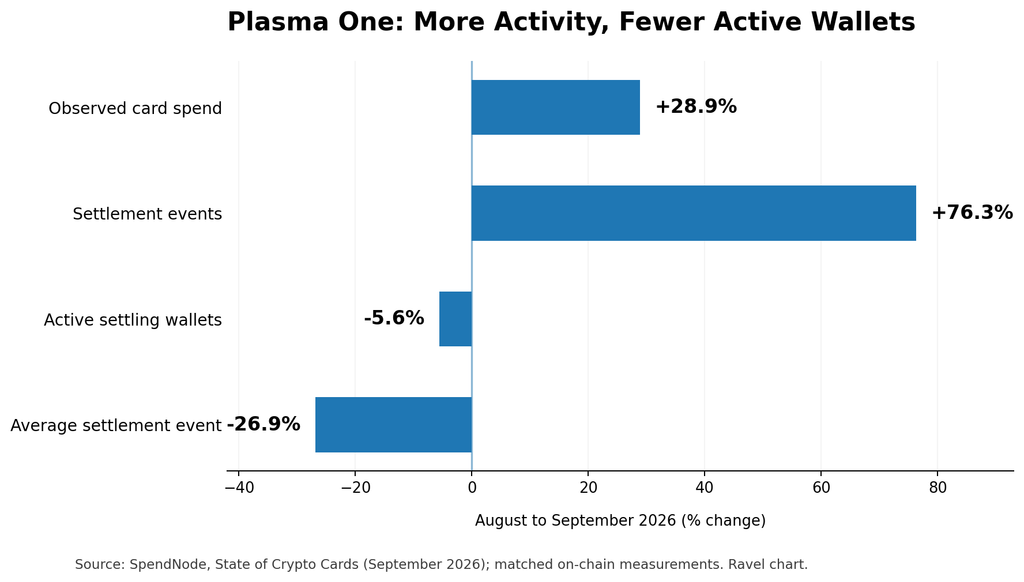
The divergence is more revealing when we calculate activity per wallet.
Using SpendNode’s September figures, Ravel calculated 10.6 settlement events per active wallet, compared with 5.7 in August.
That’s an increase of roughly 86.8% in the average number of observed events per active wallet.
This does not prove that a small group of users accounts for most spending. An average cannot reveal the underlying distribution, and the available data doesn’t establish whether particular wallet owners increased their spending disproportionately.
Nor is every on-chain settlement event necessarily a single retail purchase. Card programs can aggregate or record financial activity differently.
But the arithmetic suggests something worth investigating.
Plasma One’s measured business is growing faster in activity than in the number of wallets participating.
For investors hoping to see mass adoption, those are not interchangeable outcomes.
A product processing more payments through existing users can become economically valuable. In fact, greater engagement from established customers may be preferable to acquiring large numbers of users who rarely transact.
But it is different from demonstrating rapidly expanding user adoption.
The September figures support increasing observed usage, not a definitive conclusion that Plasma One has acquired a substantially larger active customer base.
There’s also the question of how much of the spending reflects durable demand rather than promotional incentives.
Plasma One offers cashback benefits, with rewards varying across its membership tiers.
Higher rewards can attract activity, but they also create costs. The long-term economics depend on whether the program can retain users and generate sufficient revenue as promotional spending changes.
Independent research published by sniff traced elements of Plasma One’s rewards and token-locking activity. Its findings suggest that cashback distribution and locked XPL balances are important parts of the product’s current economics.
That research also highlights a distinction between customer spending and tokenholder returns: activity inside the card program doesn’t automatically mean the company is buying XPL from the market.
Then came another major announcement.
On October 15, Stripe and Plasma announced a collaboration to develop a multi-currency stablecoin card experience.
The proposed products would support payments across different currency balances, potentially reducing unnecessary conversions for people and businesses operating internationally.
This is a credible commercial direction. Stripe already operates substantial financial infrastructure, while Plasma is developing consumer-facing stablecoin products.
But the announcement describes development plans, not evidence that every proposed feature is already available through Plasma One.
Nor does it disclose how much revenue Plasma might eventually receive from the collaboration.
The broader Stripe infrastructure coverage cited in the announcement should not be confused with the number of customers already using a completed joint product.
It’s an important partnership.
It is not yet a financial performance report.
And even if the partnership succeeds, there’s another problem investors need to confront.
A successful stablecoin card business and a successful XPL investment are not necessarily the same thing.
XPL Lost 95%. The Business Still Has to Prove How the Token Benefits
Plasma’s token reached an all-time high of $1.68 on September 27, 2025.
By October 28, 2026, market data tracked by CoinGecko placed XPL around $0.074.
That’s a decline of about 95.6%.
The fall looks even more dramatic alongside the original public-sale price.
Participants who acquired XPL at $0.05 entered at a very different valuation from investors who purchased near the market peak.
At $0.074, the quoted token price remains around 48% above the public-sale price, before trading costs and any realized transactions.
That doesn’t mean early participants are all profitable, or that they still hold their allocations.
It means the same token can produce radically different investment outcomes depending on when its holders entered.
But price performance is only part of the picture.
Plasma’s circulating supply has expanded, and the token continues moving through a multi-year vesting schedule.
According to its original tokenomics disclosure, the initial 10 billion XPL allocation reserved 40% for ecosystem growth, 25% for the team, 25% for investors, and 10% for the public sale.
Team and investor allocations were subject to a one-year cliff followed by monthly releases.
That initial cliff passed on September 25, 2026.
One-third of each allocation became eligible to unlock, representing 1.67 billion XPL across the two groups.
The release of those tokens doesn’t prove they were immediately sold. But it changes the potential supply available to the market.
Meanwhile, DefiLlama reports 4.76 billion XPL in circulating supply as of October 28.
The ongoing schedules imply 227.8 million XPL in combined monthly releases from ecosystem, team, and investor allocations, subject to the applicable vesting terms.
That’s equivalent to roughly 4.8% of the current circulating supply per month.
Again, an unlock is not an executed sale. Some recipients may hold their tokens, move them between wallets, or use them elsewhere in the ecosystem.
But the scale matters when assessing the token’s potential supply pressure.
Now consider the demand side.
Plasma’s Platinum card membership requires users to lock 100,000 XPL for 12 months to access its premium benefits.
That creates a direct utility for the token.
Independent on-chain research estimated that Plasma One’s membership programs had locked around 120 million XPL by October 18–20.
That’s significant.
But it’s equivalent to 52.7% of one month’s combined scheduled token releases.
The comparison is illustrative, not a prediction of net selling pressure. Card locks have different durations and purposes from vested investor tokens, and future demand could increase.
Still, it shows the scale of the challenge.
For XPL to benefit directly from growing card usage, the ecosystem needs sustained token demand or other mechanisms that absorb available supply.
Locking tokens for premium membership is one mechanism. Network transaction fees and validator participation represent others.
But Plasma’s signature product feature complicates the traditional blockchain investment narrative.
The network is designed to offer zero-fee USDT transfers through specified routes.
That’s attractive to users.
For XPL holders, however, reducing transaction costs can also mean limiting one potential source of fee-driven token demand.
As Ravel explained in its examination of who pays for gas-free crypto transactions, removing visible fees from a user’s experience doesn’t necessarily eliminate the underlying economic cost.
On October 28, DefiLlama’s Plasma dashboard reported only about $77 in chain fees over 24 hours.
During the same period, applications on Plasma generated roughly $121,700 in app fees.
Those figures measure different economic layers.
The application fees belong to the respective applications under their own business models. They cannot simply be counted as revenue accruing to Plasma validators or XPL holders.
Likewise, the small chain-fee figure does not mean Plasma’s economy is worthless. Low transaction costs are part of what the network is trying to offer.
But the gap illustrates a challenge that has become familiar across crypto infrastructure.
A blockchain can host valuable activity without capturing much of that economic value directly through its native token.
XPL’s tokenomics include base-fee burning and a proposed transition toward external validators earning staking rewards once the relevant infrastructure is activated.
Those mechanisms could strengthen token utility over time.
But they don’t establish that every dollar of card spending generates a proportional benefit for XPL.
A user can spend stablecoins through a card without necessarily purchasing additional XPL. A DeFi application can collect fees without distributing them to XPL holders. And a partnership announcement can expand a company’s commercial opportunities without changing the token’s immediate cash-flow rights.
This doesn’t make Plasma’s strategy fundamentally flawed.
In fact, prioritizing useful financial products over expensive blockchain transactions may be commercially sensible.
But it means investors have to evaluate two stories separately.
One concerns whether Plasma can build a competitive stablecoin payments business.
The other concern is whether the economics of that business will eventually create enough lasting demand for XPL to support its market valuation and expanding supply.
Those outcomes may reinforce each other.
They are not guaranteed to move together.
And the distinction becomes particularly important when looking back at the investment frenzy that originally surrounded the project.
The $373 million public-sale figure represented purchase commitments, not $373 million of proceeds raised against a $50 million allocation.
The $6.6 billion Aave peak demonstrated extraordinary initial liquidity attraction, not permanently committed capital.
The $25.6 million card-spending figure represents measurable activity, not company profit.
And the current value of XPL represents market pricing, not a direct accounting claim on the entire business operating around Plasma.
Each number describes something real.
None should be used as a substitute for the others.
What Plasma Still Has to Prove
This investigation draws on dated public disclosures, DefiLlama snapshots, and third-party on-chain settlement research. Ravel calculated the Aave TVL decline, changes in average settlement events per active wallet, and the relative scale of token locks and scheduled unlocks.
The card metrics are observations of mapped settlement activity, not audited company revenue or counts of unique human customers. The historical $6.6 billion Aave peak and October 2026 TVL snapshot also come from different reporting contexts, so the 93% comparison should be treated as a scale comparison rather than a reconciled capital-flow statement.
No observed token unlock is assumed to have been sold, and no card settlement is assumed to generate automatic XPL demand.
These limits don’t undermine Plasma’s progress.
They define what that progress actually proves.
A year after its extraordinary debut, Plasma still has substantial stablecoin liquidity, a functioning DeFi ecosystem, growing observed card spending, and a financial product strategy supported by a major payments company.
Those achievements deserve recognition.
But the next phase will hinge on questions that launch-day deposits could never answer.
Can Plasma One maintain payment growth without relying indefinitely on generous incentives? Will the number of active customers expand alongside transaction activity? Can the company build durable margins around the services it provides?
And perhaps most importantly for investors: what mechanism will turn growing business usage into lasting demand for XPL?
Plasma’s first year demonstrated that it could attract billions of dollars to a new blockchain.
The year since has revealed how difficult it is to keep that capital, and how much harder it can be to connect a useful financial product to a valuable token.
Plasma may be building the business investors hoped for. The question is whether XPL holders will share in its success.