
A billion dollars in token unlocks sounds like the kind of thing that should make cryptocurrency traders nervous.
Unless, of course, the billion dollars arrives differently than the calendar suggests.
That is the strange situation surrounding Hyperliquid’s HYPE token this week. One tokenomics platform listed a $1.1 billion unlock for October 29. Another calendar pointed to nearly $900 million on the same date. A third tracker placed the next major contributor release on November 6 instead.
And then there were the wallets.
Earlier this month, 3.75 million HYPE moved out of Hyperliquid Labs’ staking account in a transaction valued at more than $300 million. The tokens passed through five intermediary addresses before reaching a wallet associated with an institutional over-the-counter transaction.
But rather than showing a straightforward march toward public exchanges, subsequent tracking revealed something different: millions of HYPE sitting in staking.
The distinction matters because an unlock calendar, a blockchain transfer, and an actual market sale are three very different things.
For investors trying to understand how much HYPE could enter circulation, treating them as interchangeable can turn a useful warning into a misleading headline.
The Billion-Dollar Unlock That Calendars Couldn’t Agree On
The confusion begins with a date.
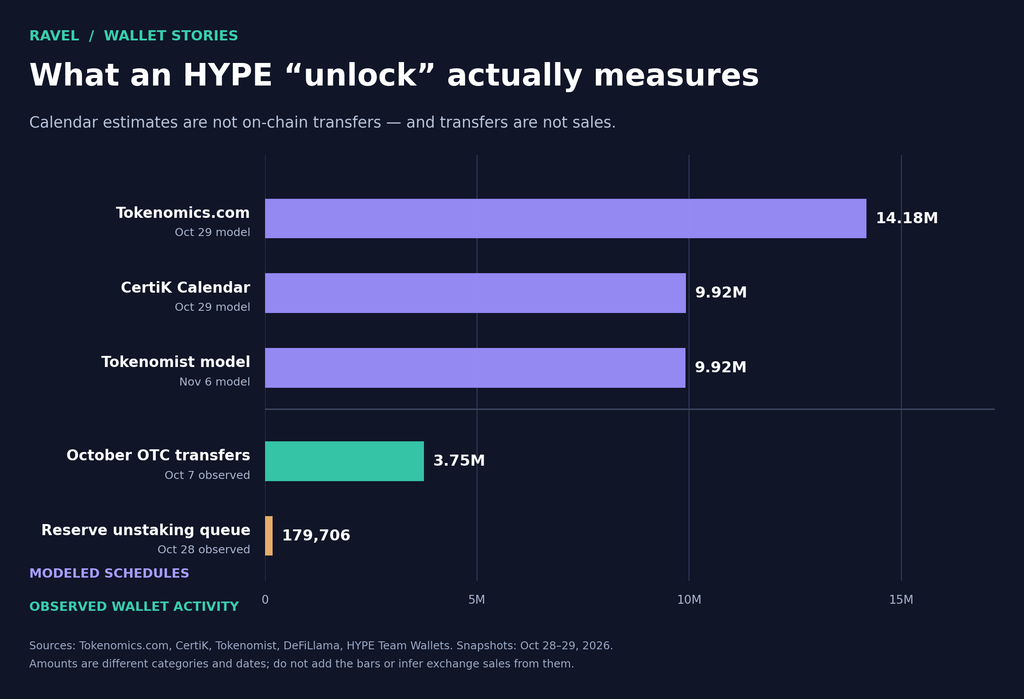
On October 29, Tokenomics.com displayed a scheduled release of 14,175,778 HYPE, worth roughly $1.1 billion using its market assumptions.
The platform divided that amount across three categories: 46.6% for insiders, 46.3% for community allocations, and 7% for the foundation.
Ravel’s calculations put those allocations at roughly 6.61 million, 6.56 million, and 992,000 HYPE, respectively. The percentages are rounded, so the calculated amounts do not add up perfectly.
That is an important detail. The $1.1 billion headline wasn’t describing only contributor tokens that might immediately reach trading venues. It combined several allocation categories with potentially different release mechanics.
Meanwhile, CertiK’s token unlock calendar listed 9.92 million HYPE for October 29, valued at roughly $895 million in its snapshot.
Same token. Same date. Several million fewer coins.
Then comes Tokenomist, which tells a different story.
Its next modeled Core Contributors release falls on November 6, with roughly 9.92 million HYPE scheduled under the vesting model.
The discrepancy is easier to understand once you follow the history of that model.
On December 28, 2025, Tokenomist updated its release schedule after Hyperliquid co-founder Iliensinc clarified the timing of team distributions through the project’s Discord community.
Future monthly distributions, when they occurred, would take place on the sixth day of the month rather than the previously assumed 29th.
Tokenomist adjusted its calendar accordingly.
But there was a catch embedded in its methodology: the model continued to assume vesting across the full contributor allocation.
In other words, November’s 9.92 million HYPE represents a modeled release under those assumptions. It does not establish that Hyperliquid Labs has already prepared that exact quantity for distribution.
The discrepancy isn’t simply a matter of which website has the right calendar.
The trackers are also measuring different categories of supply.
A theoretical vesting schedule estimates when an allocation becomes available under specified assumptions. A distribution tracker measures tokens that actually leave designated wallets. An exchange-flow tracker attempts to identify whether those tokens subsequently reach trading venues.
Those measurements can disagree without necessarily contradicting one another.
That’s especially relevant to Hyperliquid, where contributor tokens often remain in staking before their owners initiate a withdrawal.
The blockchain has a waiting period that the calendars cannot simply wish away.
According to Hyperliquid’s official staking instructions, transferring HYPE from a staking account into a spot balance requires seven days.
That creates an observable trail before the tokens become transferable.
And October’s trail is considerably more revealing than the billion-dollar headlines.
Five Wallets, 3.75 Million HYPE, and an Unexpected Staking Trail
On September 30, Hyperliquid Labs began withdrawing 3.75 million HYPE from staking.
The distribution was tied to an institutional OTC agreement, according to statements attributed to the team. Unlike a sale executed directly through a public exchange order book, an OTC transaction allows counterparties to negotiate and settle a block of tokens privately.
That distinction limits the immediate order-book impact of the transaction itself. It doesn’t guarantee that the buyer will never sell the tokens afterward.
By October 7, the seven-day waiting period had ended.
What followed was a series of transfers through five intermediary addresses.
Early reports identified 375,000 HYPE arriving at each address, accounting for half the total batch. But subsequent tracking showed that each had cumulatively received 750,000 HYPE.
The updated figures are visible in DeFiLlama’s Hyperliquid unlock dashboard.
Together, those five addresses received 3.75 million HYPE.
Each subsequently transferred its full allocation onwards, leaving no spot balance in the five addresses at the time of the reviewed snapshot.
That might sound like a wave of selling.
It isn’t proof of one.
A token leaving an intermediary wallet may move into another custody account, an OTC settlement structure, or a staking account. Public blockchain data can show the movement without revealing the commercial terms behind it.
The next destination is where the story becomes more interesting.
On October 8, on-chain tracking reported by Lookonchain connected the transfers to an address beginning 0x8757 and ending 31d1.
At the time, analysts identified 1.25 million HYPE entering staking, while another 2.5 million HYPE remained outside the reported staking position.
That was the initial picture.
During Ravel’s subsequent review of Blockworks Analytics, the same destination address appeared among Hyperliquid’s largest delegators.
Its recorded delegated balance had reached 3,127,505 HYPE, worth roughly $251.3 million at the dashboard’s reference price.
That is nearly 1.88 million HYPE, more than the 1.25 million initially identified as restaked on October 8.
The newer staking position is also equivalent to 83.4% of the original 3.75 million-HYPE OTC batch.
That comparison is striking, but it needs a qualification.
The address-level staking balance is a later snapshot, not a complete transaction-by-transaction reconstruction of the original OTC coins. The wallet could have received other deposits, changed delegations, or accumulated rewards.
So the data does not prove that precisely 83.4% of the OTC allocation remained staked, nor that the other 16.6% was sold.
What it does establish is that the address associated with the October transfer trail subsequently held a substantial delegated staking position.
The validator receiving that delegation adds another twist to the story.
Blockworks identifies the validator as Hyperliquid Strategies x Unit.
That name might tempt readers to conclude that Hyperliquid Strategies purchased the institutional OTC allocation.
But that’s not what the evidence says.
In a filing with the US Securities and Exchange Commission, Hyperliquid Strategies explains that its validator accepts delegations from third-party HYPE holders.
The company does not necessarily own the tokens delegated to its validator.
Its leadership also publicly denied being the buyer in the October OTC transaction.
Consequently, staking through the Hyperliquid Strategies x Unit validator should not be confused with proof of ownership by Hyperliquid Strategies itself.
The counterparty’s identity and purchase price remain unverified.
Still, the wallet trail reveals something economically important.
The original distribution did not end with a documented, straightforward liquidation of the entire allocation on public exchanges. A substantial staking position emerged at an address connected to the transfer sequence.
Staking doesn’t permanently remove selling risk. Holders can eventually withdraw and sell.
But it does tell a different story from a calendar that simply displays hundreds of millions of dollars becoming available on one date.
The Next Unlock Isn’t Necessarily the Next Sell Order
The forward-looking picture is just as complicated.
On October 28, an address attributed to Hyperliquid Labs initiated another withdrawal process involving 179,706 HYPE.
The reserve address is
0x43e9abea1910387c4292bca4b94de81462f8a251
During Ravel’s review, the HYPE Team Wallets monitor showed the same quantity in the reserve account’s unstaking queue.
Using the reported seven-day waiting period, the tokens would become available around November 4.
That is two days before Tokenomist’s next modeled contributor release.
Now compare the quantities.
Tokenomist’s modeled November release is roughly 9.92 million HYPE. The observed reserve withdrawal request involved 179,706 HYPE.
The queue represents just 1.81% of the modeled amount.
It’s a dramatic numerical gap, but it doesn’t prove that the November release will ultimately total only 179,706 HYPE.
The measurements cover different things. The model estimates an allocation-wide vesting event. The observed queue captures a specific withdrawal request associated with the reserve address at a particular moment.
Other transfers or withdrawals may occur before the distribution date. Not every available token needs to pass through the same observable process at the same time.
For now, however, the reserve activity provides a more concrete indication of near-term token mobility than assuming the entire modeled unlock has become sellable supply.
There’s also another piece of Hyperliquid’s supply story worth considering: the Assistance Fund.
According to Strata Terminal’s HYPE buyback tracker, the fund purchased around $62.3 million of HYPE during the 30 days ending October 29.
The tracker estimates cumulative purchases of $1.39 billion, excluding initial allocations that did not involve actual market purchases.
Those figures help explain why buybacks feature so heavily in the bullish case for HYPE.
But comparing buybacks with token unlock headlines requires care.
At a reference price of $79.20, October’s 3.75 million-HYPE distribution would have a market value of $297 million.
That’s roughly 4.8 times the Assistance Fund’s reported 30-day purchases.
It would be tempting to subtract the buyback total from the distribution value and then declare the difference as net selling pressure.
That would produce a neat number—and a rather poor explanation of what happened.
The October OTC distribution was not equivalent to $297 million of public-market sell orders. Some tokens subsequently appeared in staking, while the buyer’s transaction price and future disposal plans remain unknown.
Meanwhile, the Assistance Fund’s purchases represent buying activity through a different mechanism and over a different observation period.
Strata’s methodology also distinguishes tokens bought and held by the fund from tokens that have actually been burned.
The two dollar figures, therefore, cannot be netted into a reliable estimate of market impact.
The same caution applies to price performance.
A large transfer may affect sentiment, especially when traders fear future selling. But spotting a HYPE price decline around a token distribution does not mean the transferred tokens caused the decline.
Market conditions, leveraged positioning, liquidity, and unrelated catalysts can all contribute.
This is where wallet analysis becomes useful, provided it doesn’t turn every transfer into a trading signal.
A token becoming eligible for release changes its potential supply status. An unstaking request makes that potential more concrete. A transfer changes custody. An exchange deposit may indicate preparation to trade.
Even an exchange deposit doesn’t prove a completed sale.
Each step narrows the possibilities, but none should be mistaken for the next.
That is the real lesson in Hyperliquid’s October unlock story.
Different trackers can give very different answers because they are not always asking the same question. Meanwhile, actual wallet movements can reveal a more nuanced picture than a headline about a billion dollars entering circulation.
Ravel’s review does not establish that any unlock provider deliberately misled investors, nor does it identify the October OTC buyer. The transaction trail and subsequent delegation figures also require historical account-level reconciliation before anyone can claim a definitive final destination for every coin.
But the evidence is enough to challenge a familiar shortcut in crypto analysis.
The date on a vesting calendar isn’t the date every token gets dumped. The transfer out of a wallet isn’t proof of a sale. And a large staking position doesn’t guarantee those tokens will stay off the market forever.
A calendar tells you what might become available. The blockchain tells you what moved. Only the trading evidence can tell you what actually sold.