
Imagine betting that a company will sell Bitcoin before a deadline. The company sells Bitcoin. Its official regulatory filing confirms the transaction.
You should win, right?
Not necessarily.
In June 2026, traders on Polymarket discovered just how expensive that distinction could become. Strategy, Michael Saylor’s Bitcoin treasury company, disclosed that it had sold 32 BTC worth $2.5 million between May 26 and May 31.
Yet a prediction market asking whether Strategy would sell Bitcoin by May 31 ultimately settled as NO.
The Bitcoin sale wasn’t imaginary. Strategy confirmed it in a June 1 filing with the Securities and Exchange Commission. What traders disagreed about was something considerably less exciting: whether confirmation had arrived before the contract’s deadline.
The dispute exposed an overlooked feature of prediction markets. Traders don’t simply bet on what happens in the real world. They buy contracts whose payouts depend on how specific rules interpret those events.
Those rules can turn an apparently correct prediction into a losing position.
And as prediction markets expand across politics, crypto, finance, and global events, understanding that distinction is becoming an essential financial skill.
The Bitcoin Sale That Somehow Became a Losing Bet
The controversy began with a relatively straightforward question.
Would Strategy sell any of its Bitcoin by May 31, 2026?
The Polymarket contract specified that the market would resolve YES if the company sold Bitcoin before the stated deadline. Its listed resolution sources included information from Strategy, on-chain data, and a consensus of credible reporting.
For traders buying YES, the logic appeared simple. A Bitcoin sale before the deadline meant a winning contract.
Then June 1 arrived.
Strategy’s regulatory disclosure confirmed that the company had sold 32 BTC during the preceding reporting period. The transaction itself occurred within the dates covered by the prediction market.
But the public confirmation arrived after May 31.
That difference triggered a fierce argument over what the contract actually required.
YES holders pointed to the company’s filing. The sale had happened during the specified period, and the original wording referred to the transaction itself.
NO holders focused on verification. Without publicly available confirmation before the deadline, they argued, the market couldn’t establish that the condition had been satisfied in time.
Polymarket subsequently added context, explaining that confirmation outside the market’s timeframe wouldn’t qualify.
For critics, that looked like an additional condition introduced after the relevant event. For supporters of the NO interpretation, it clarified how the original deadline should apply.
The disagreement went beyond social media.
Two proposed NO outcomes faced challenges before the case reached UMA’s dispute-resolution process. Ultimately, UMA token holders upheld the NO result.
The official market record still shows the May 31 contract settling as NO, even though the company confirmed selling Bitcoin during the covered period.
Neither the filing nor the settlement record is inherently contradictory. They answer different questions.
One establishes when Strategy reported making a transaction. The other records how a particular financial contract resolved after participants disputed its interpretation.
That distinction is precisely what made the incident so consequential.
Polymarket’s own guidance on market clarifications states that the market title describes the question, while the detailed rules determine settlement.
The platform also allows clarifications in unusual circumstances, although its documentation says they cannot change a question’s fundamental intent.
That creates an important boundary between explaining existing rules and changing what traders reasonably understood when entering a position.
In the Strategy case, market participants fundamentally disagreed about where that boundary lay.
The outcome settled the contracts. It didn’t eliminate the underlying question.
When a market asks whether something happened, does its deadline govern the event itself or the evidence confirming it?
Unless the rules answer that clearly, traders may find themselves betting on two different interpretations of the same sentence.
Who Actually Decides Whether a Prediction Comes True?
Most people encounter prediction markets through probabilities.
A political candidate has a 70% chance of winning. Bitcoin has an 85% chance of reaching a certain price. A company has a 95% chance of announcing a product before year-end.
The interface makes these markets look like straightforward forecasts.
Behind each price, however, sits a contractual settlement process.
For a standard binary market, a winning YES or NO share pays $1 after final resolution. The losing share becomes worthless.
Determining which share wins requires a mechanism for bringing real-world information onto the blockchain.
That’s the oracle’s job.
Polymarket’s resolution documentation explains how markets using UMA’s Optimistic Oracle handle this process.
Rather than having a single authority continuously decide every outcome, the system allows participants to propose results and challenge them.
A proposer generally posts a bond worth $750 and submits an outcome. Other participants then have a two-hour window to dispute it.
If nobody challenges the proposal, the result can become final.
If someone disagrees, the process moves into another proposal round. A second challenge can trigger UMA’s Data Verification Mechanism, where UMA token holders vote on the outcome.
Evidence and arguments can enter the process before the final decision.
This system is designed to discourage dishonest proposals through financial incentives and independent challenges.
But decentralization doesn’t magically eliminate ambiguity.
An oracle can determine which interpretation wins a dispute. It cannot guarantee that every participant understood the contract the same way beforehand.
The Strategy incident demonstrated exactly that.
It wasn’t primarily a dispute about whether Bitcoin transactions existed. The disagreement concerned how the rules connected those transactions to a reporting deadline.
And research suggests such disputes are more than isolated headaches.
An October 2026 study by Ahmed Mahrous and Roberto Di Pietro examined 802,863 resolved Polymarket contracts created between January 2023 and May 2026.
Among 529,408 markets with observable dispute histories, researchers identified 1,634 formally disputed contracts.
That’s just 0.31%.
A tiny fraction, until you look at the money flowing through those markets.
Within that same dispute-observable sample, disputed contracts accounted for 8.6% of reported trading volume.
Ravel calculates that the disputed markets’ share of trading volume was 27.7 times their share of contracts.
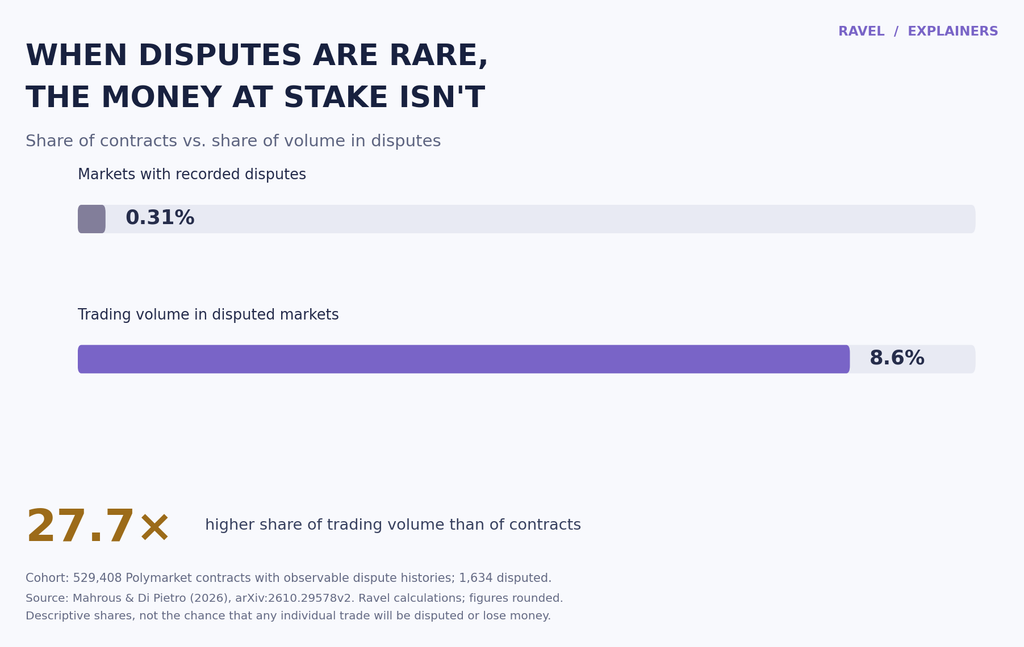
That doesn’t mean any individual trader faces a 27.7 times greater chance of losing money. It indicates that disputes were disproportionately associated with trading activity in the historical sample.
The researchers also found a relationship between contract complexity and disputes.
After adjusting for relevant characteristics, each additional Flesch–Kincaid reading-grade level in contract rules corresponded to 23% higher odds of a formal dispute.
The study identified another pattern: markets without an identifiable resolution source had much higher dispute odds than those relying on mechanical data feeds.
These are statistical associations, not proof that complicated wording directly causes disputes. Some markets deal with inherently difficult events that require more detailed rules.
Still, the implication is difficult to ignore.
The more interpretation a contract requires, the more important its wording becomes.
A market tied to an exact exchange-rate feed has a relatively mechanical answer. A market asking whether a politician made a threat, whether a company sold assets, or whether an announcement counts before a deadline can involve considerably more judgment.
That’s why reading only the market title is a surprisingly expensive habit.
The Hidden Risk Behind a 95% Probability
Now consider what happens when traders mistake a high implied probability for an almost guaranteed profit.
Suppose a YES contract trades at $0.95.
You buy 100 shares.
Your investment costs $95. If YES wins, the shares pay $100, leaving you with a $5 profit before fees.
If NO wins, you lose the entire $95.
Your potential loss is 19 times your potential profit.
The trade needs a true settlement probability above 95% to have positive expected value, ignoring trading costs.
That sounds manageable if you’re convinced the event has a 98% chance of happening.
But what if your confidence only concerns the real-world event, not how the contract will settle?
Consider a hypothetical scenario.
You estimate a 95% probability that an event occurs. You also estimate a 98% probability that the contract settles YES, conditional on that event occurring.
Assume the contract cannot legitimately settle YES if the event never happens.
Under those assumptions, your estimated probability of receiving the YES payout becomes:
95% × 98% = 93.1%
For 100 shares costing $95, your expected payout becomes $93.10.
That produces an expected loss of $1.90 before fees, despite your strong belief that the underlying event will happen.
These probabilities are illustrative assumptions, not estimates from Polymarket data. Their purpose is to separate confidence in an event from confidence in the contract’s settlement.
This is a useful distinction because a prediction market price represents the payout attached to the contract, not a guarantee that its resolution rules match your interpretation of the headline.
Of course, settlement ambiguity is not the only reason prices can diverge from genuine probabilities. Liquidity, trading fees, market-maker behavior, and demand also matter.
But settlement risk has an unusual feature.
It can remain invisible until the very moment traders expect their contracts to pay.
The industry’s infrastructure is changing, too.
Polymarket began testing its new Protocol V2 architecture in October 2026, with a tentative November 2 transition for newly created markets.
Its published V2 code introduces a modular OracleAggregator that can support different resolution systems, including UMA and Chainlink-based mechanisms.
The distinction matters. Some markets require interpretation of announcements or real-world events, while others rely on defined data feeds and mathematical comparisons.
Polymarket’s V2 migration documentation also confirms that existing Conditional Tokens Framework positions will not automatically convert into V2 positions.
So traders shouldn’t assume every existing and newly launched contract follows an identical technical path.
A modular architecture can improve flexibility and allow more suitable data sources for different markets.
But it cannot eliminate every disagreement over language.
Even sophisticated infrastructure still needs someone to decide what a contract means when the real world refuses to fit neatly into its wording.
For traders, the practical lesson begins before placing an order.
Read the settlement conditions, not just the headline. Check whether the deadline applies to an event or its public confirmation. Identify the resolution source and decide whether it can provide an objective answer.
Then look for the awkward cases.
What happens if an announcement arrives late? What if reliable sources disagree? Can the platform clarify the rules after trading begins? Which oracle handles the contract, and what happens if someone challenges the proposed result?
Finally, compare those uncertainties with the potential reward.
A contract offering five cents of profit against 95 cents of possible loss leaves little room for a misunderstanding.
None of this makes prediction markets useless. Their prices can still aggregate valuable information, and clear contracts can settle with little controversy.
But the Strategy episode revealed something that a probability display cannot explain on its own.
There are two ways to be right in a prediction market.
You can correctly predict what happens in the world. Or you can correctly predict how a contract will interpret what happens.
Ideally, those answers are identical.
When they aren’t, the second one determines who gets paid.