


Hollywood has its new James Bond. Prediction markets have a rather awkward receipt.
On November 16, Amazon MGM Studios officially named Robert Pattinson as the next 007, ending months of speculation about who would succeed Daniel Craig.
But the betting markets were indicating something else.
Just days before the announcement, traders were still favoring other actors. And across Polymarket and Kalshi, the race eventually generated more than $8.86 million in combined trading volume.
The interesting question isn’t whether Pattinson won the role. That’s settled.
It’s how much confidence traders actually had in that outcome before Hollywood made it official.
Pattinson Wasn’t the Favorite a Week Earlier
The timeline tells the story.
On November 9, Kalshi’s own market update placed Pattinson’s probability of becoming Bond at 29%.
Jack Lowden led with 31%.
Three days later, the picture had shifted again.
According to Kalshi’s November 12 update, Callum Turner had moved into first place at 34%, followed by Pattinson at 32% and Lowden at 30%.
Pattinson had gained three percentage points since November 9, but he still wasn’t the favorite.
Then came November 16.
Amazon MGM Studios confirmed that Pattinson would star in its upcoming James Bond film, directed by Denis Villeneuve from a script by Steven Knight.
The uncertainty disappeared. The historical market prices, however, reveal how divided traders had been.
$8.86 Million Traded on the Next 007
The financial footprint is substantial.
As observed on November 17, Polymarket’s James Bond market displayed $3,588,905 in cumulative trading volume, with Pattinson’s outcome showing 100%.
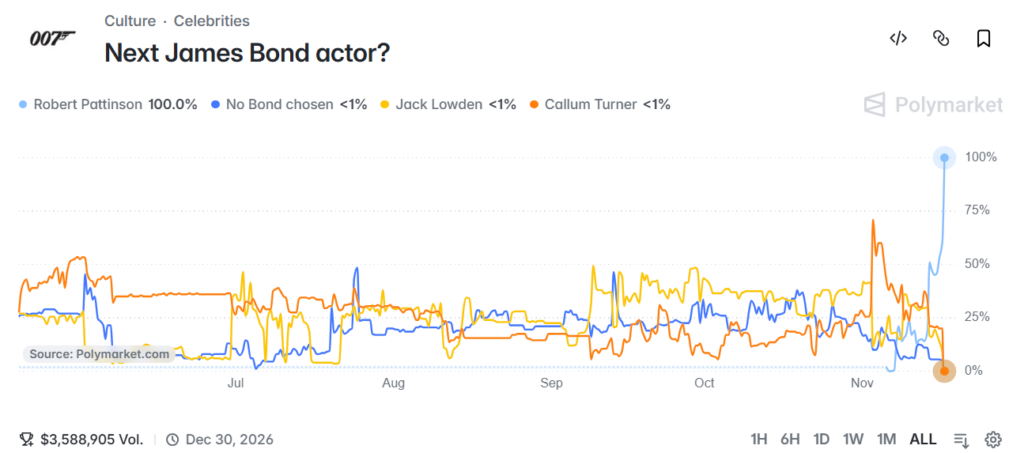
Meanwhile, Kalshi’s corresponding market showed $5,271,484 in trading volume, and Pattinson’s contract was determined as “YES.”
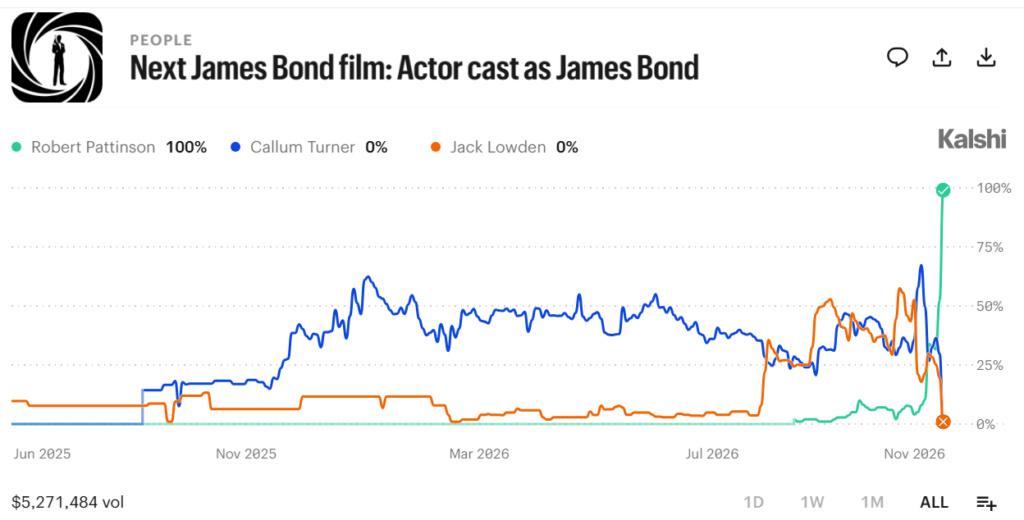
Combined, that’s $8,860,389.
Yet this figure needs an important qualification.
Trading volume isn’t the same as money lost, total outstanding stakes, or the amount traders collectively committed to incorrect predictions.
Contracts can change hands repeatedly, generating additional volume without requiring an equivalent amount of fresh capital.
And the two venues aren’t identical: Polymarket operates crypto-based prediction markets, while Kalshi offers regulated event contracts.
The combined number measures activity across two separate marketplaces, not one unified pool of crypto wagers.
A 29% Bet Could Have Returned More Than Triple
Here’s where the probability becomes financially compelling.
Consider a hypothetical trader purchasing a winning YES contract at 29 cents, corresponding to Pattinson’s November 9 implied probability.
If that contract ultimately paid $1, the arithmetic would be straightforward:
- Entry cost: $0.29
- Winning payout: $1.00
- Profit per share: $0.71
- Return on entry cost: 244.8%, before fees
In other words, every dollar spent at that hypothetical entry price could have returned roughly $3.45 in total.
That doesn’t establish that anyone actually secured that price, held the position, or earned that return.
The historical probability snapshot is not an executed trade record.
But it illustrates why a casting decision can create meaningful financial consequences for traders of event contracts.
As Ravel previously explored in its investigation into prediction-market bets on Jensen Huang’s potential Nvidia return, a contract’s price can reveal more about market expectations than the eventual YES or NO outcome alone.
Did Prediction Markets Actually Get Bond Wrong?
Not necessarily.
A 29% probability doesn’t mean an outcome is impossible. It means the market considered it less likely than the alternatives.
An event assigned a 29% chance can still happen without invalidating the original forecast.
That’s the distinction between predicting an outcome and assigning a probability to it.
The available dated snapshots establish that Pattinson trailed competing actors on November 9 and November 12. They don’t establish who led during every hour before Amazon’s announcement or whether particular traders anticipated the decision ahead of everyone else.
Nor does a successful resolution prove that every winning position was profitable. Entry prices, exit prices, and settlement conditions matter, as Ravel’s investigation into prediction-market settlement rules demonstrates.
Pattinson’s casting provides a useful test of what these markets actually measure.
They don’t necessarily identify the next James Bond before Hollywood does.
They put a price on uncertainty while everyone else is still trying to guess.
And in this particular race, the winning actor wasn’t always the one traders wanted to back.