


Berachain had a compelling answer to one of crypto’s oldest problems: what if a blockchain could reward the liquidity its applications actually needed, rather than simply paying validators to keep the network running?
It’s called the idea of Proof of Liquidity.
The pitch helped turn Berachain into one of 2025’s most closely watched blockchain launches. Money poured in, applications competed for incentives, and a network built around rewarding useful capital appeared to have found its audience.
By the end of March 2025, Berachain had accumulated $5.2 billion in decentralized finance total value locked (TVL), according to CoinGecko’s first-quarter industry report.
Then the money began to leave.
By November 10, 2026, Berachain’s DeFi TVL had fallen to roughly $30 million. That represents a 99.4% decline in dollar terms from the March 2025 figure.
But the more revealing collapse happened somewhere else.
Ravel examined the historical incentive payments underpinning Berachain’s Proof of Liquidity marketplace. In April 2025, those payments reached $7.46 million. By June 2026, they had fallen to just $176,321.
That’s a decline of about 97.6%.
And it happened before Berachain activated the major tokenomics overhaul intended to make its economic model more sustainable.
The network did not stop issuing rewards. It changed the rules governing what those rewards were supposed to accomplish.
Nearly four months later, the question is whether those changes have begun producing something its original design struggled to demonstrate: durable economic value.
The Billions Were Real. Their Permanence Wasn’t
Berachain launched its mainnet on February 6, 2025, with an unusual design.
Most proof-of-stake networks reward validators for securing the blockchain. Berachain’s Proof of Liquidity added another layer, directing emissions toward applications and liquidity providers.
The original system revolved around BERA, the network’s gas token, and BGT, a nontransferable governance and reward token.
Applications could offer incentives to attract the allocation of BGT emissions. Liquidity providers earned rewards through eligible vaults, while validators played a central role in determining where those emissions went.
In theory, this created a competitive market in which liquidity would flow toward applications offering the most attractive economic opportunities.
It was an appealing alternative to the familiar cycle of attracting deposits with token rewards, watching those rewards diminish, and discovering how little activity remained afterward.
Berachain also had considerable momentum.
Its Boyco pre-deposit program attracted around $2.3 billion before launch, helping establish substantial day-one liquidity.
That matters when interpreting the network’s eventual $5.2 billion TVL.
A significant amount of capital had been recruited through an organized bootstrap campaign rather than accumulating entirely through ordinary application demand.
There is nothing inherently wrong with incentivized liquidity. Almost every emerging DeFi ecosystem uses some version of it.
The question is whether that capital eventually finds reasons to stay without requiring similarly generous rewards.
Ravel explored a comparable distinction in its investigation of Plasma’s $6.6 billion liquidity boom, where headline deposits told only part of the story about lasting adoption.
Berachain’s collapse in dollar-denominated TVL is striking, but it cannot be treated as a precise measurement of capital withdrawals. Falling token prices, changing protocol coverage, and expiring incentive programs can all affect the calculation.
To understand what happened to the underlying economic activity, we need another measure.
The Incentive Market Was Shrinking Before the Upgrade
DefiLlama maintains a separate dataset called Berachain Incentive Buys.
It tracks incentive payments, often called bribes, made by protocols competing for rewards within Berachain’s Proof of Liquidity system.
These payments are not ordinary blockchain transaction fees. They represent the incentive marketplace through which applications sought to attract reward allocation.
That makes the dataset particularly useful for examining the economic activity surrounding Berachain’s original model.
Ravel reconstructed its monthly trajectory from April 2025 through June 2026, using DefiLlama’s reported monthly figures.
In April 2025, incentive payments totaled approximately $7.46 million.
They slipped to $2.68 million by June, recovered to $4.27 million in September, and declined to $1.26 million by December.
The deterioration continued throughout 2026.
January brought $1.28 million. February fell to $801,700. By April, monthly payments had reached $354,056.
June ended with just $176,321.
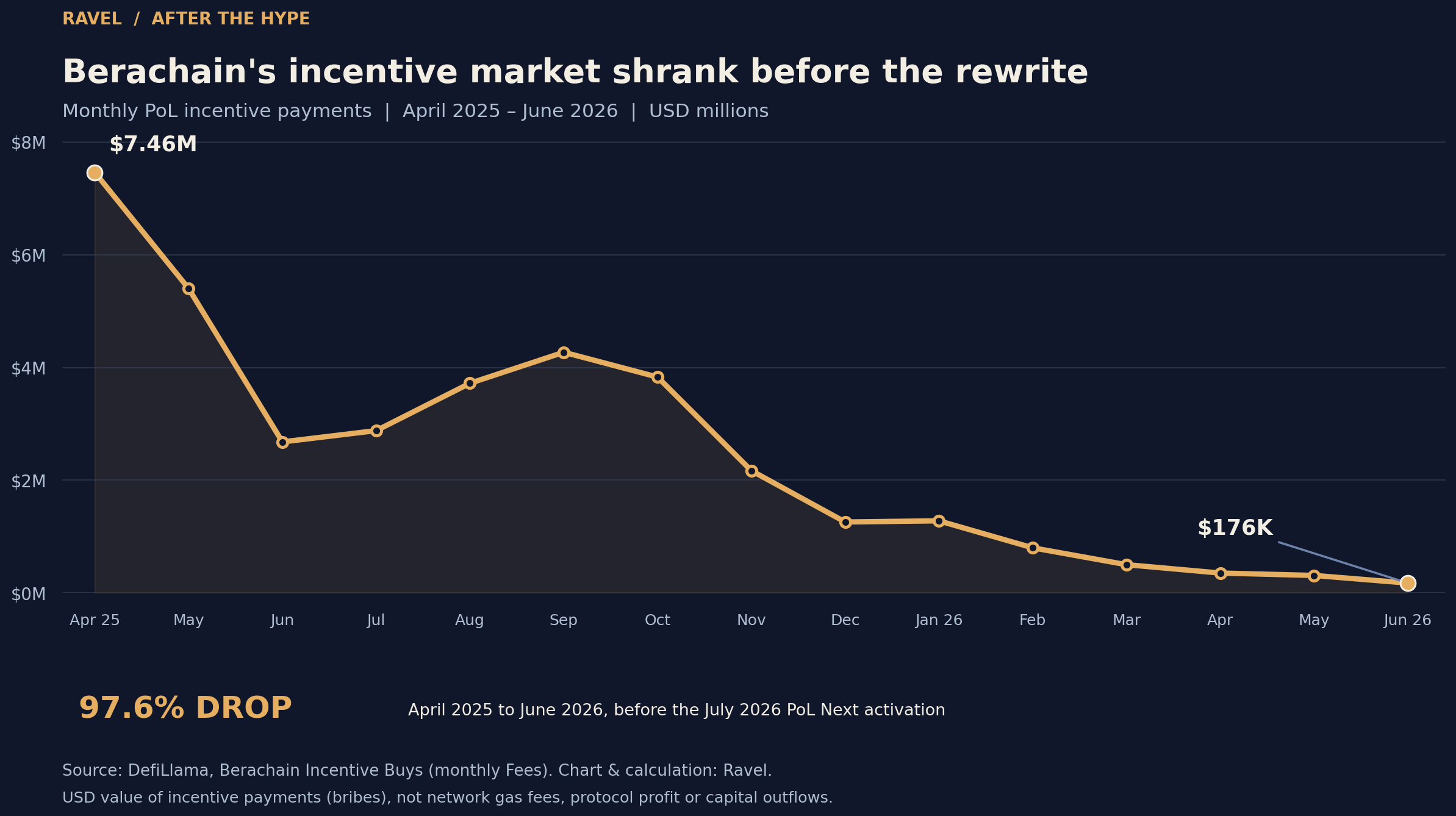
Using April 2025 as the starting point, the calculation is straightforward:
($7,460,000 − $176,321) ÷ $7,460,000 × 100 = 97.64%.
The result is expressed as roughly 97.6% because DefiLlama rounds the starting monthly figure.
There is another important detail.
Both months precede the July 2026 launch of PoL Next, meaning the comparison avoids directly mixing the old incentive system with its redesigned successor.
That does not mean payments declined exclusively because applications lost interest.
The dollar value of incentives can also change with token prices, emission rates, and market structure. Fewer dollars paid in incentives do not necessarily mean an identical percentage decline in underlying usage.
Nevertheless, the trend reveals a striking contraction in the recorded value of the marketplace that once distinguished Berachain from competing blockchains.
And the team’s own assessment suggests the problem went beyond disappointing numbers.
Berachain’s Own Diagnosis Was Uncomfortable
In February 2026, Berachain published an unusually candid update on inflation and reward vaults.
The network was reducing annual BGT inflation from 8% to 5% and reconsidering which applications should continue receiving emissions.
At the time, approximately 200 reward vaults existed on Berachain.
Only about 50 were actively receiving emissions at any given moment.
That does not establish that the other 150 vaults were failures. Reward allocation was selective, and some vaults were not necessarily expected to receive continuous distributions.
What matters is how Berachain described the conditions that could lead to vaults being removed.
The criteria included prolonged inactivity, self-farming, liquidity that contributed little economic utility, and the absence of a credible path toward generating sustainable demand.
In other words, Berachain was confronting the possibility that rewarding liquidity did not always produce the productive liquidity its model intended to encourage.
The distinction is critical.
A liquidity pool can attract deposits without supporting meaningful trading. An application can collect rewards without building a lasting user base. A large TVL figure can coexist with limited transaction fees and little recurring revenue.
Berachain was not claiming that every incentivized application had behaved this way.
But its decision to tighten reward criteria acknowledged that the original system needed stronger economic discipline.
The network had another problem, too.
In its May 21 PoL Next proposal, Berachain disclosed that liquid staking tokens had accumulated approximately 68% of BGT supply and controlled about 76% of the active validator boost.
The concentration extended into the incentive marketplace.
In a representative seven-day sample, Infrared accounted for roughly 73% of booster-side incentive flows.
That figure does not mean Infrared captured 73% of all Berachain rewards. It measures a particular component of the incentive market over a limited period.
Still, it exposed a structural problem.
Proof of Liquidity was supposed to encourage competition over emission allocation. Yet a substantial share of the decision-making influence had accumulated through liquid staking intermediaries.
Berachain’s own analysis argued that this concentration distorted how the marketplace discovered prices and directed rewards.
The system was generating incentives.
Whether it was allocating them efficiently had become a different question.
The Token Changed. The Rewards Kept Coming
On July 7, 2026, Berachain activated PoL Next, with the deployment confirmed in a July 8 announcement involving the Berachain Foundation and Greenlane.
The overhaul fundamentally changed the role of BGT.
Rather than maintaining separate BERA and BGT incentive mechanics, Berachain shifted toward rewards denominated in wrapped BERA, or WBERA, while consolidating staking-related value accrual around sWBERA.
BGT was deprecated as a user-facing component of Proof of Liquidity. Its former boost mechanics and role in determining reward allocation were removed.
The goal was to make emissions easier to understand, reduce dependence on intermediaries, and connect economic benefits more directly to BERA staking.
But changing who receives rewards is not the same as stopping their issuance.
According to Berachain’s technical documentation for PoL Next, the redesigned system established two fixed reward components per block.
Validator operators receive a base rate of 0.4 WBERA, while the reward distributor receives 1.305 WBERA for eligible reward vault distributions.
Together, that produces 1.705 WBERA per block when the applicable rewards are issued.
The corresponding BlockRewardController source code confirms the fixed-rate structure and its conditional reward-processing logic.
Assuming a consistent two-second block interval and full eligible distributions, Ravel calculates:
- 17,280 BERA in validator base rewards per day.
- 56,376 BERA allocated through reward vault emissions per day.
- 73,656 BERA in combined daily emissions.
Over 30 days, that would amount to roughly 2.21 million BERA.
The calculation represents a protocol-rate estimate, not a complete audit of realized emissions across every block.
However, the November 9 emission entries tracked by DefiLlama show the same daily split, providing a useful cross-check against the technical parameters.
Berachain’s staking mechanism is also operating on-chain.
For example, an August 22 transaction recorded by BeraScan shows a user depositing 365 BERA into the sWBERA contract and receiving approximately 251.317 sWBERA shares.
The difference in token quantities reflects the staking vault’s share-conversion mechanism, not an immediate loss of the deposited assets.
This demonstrates actual participation in the redesigned staking system, although it does not establish how much external revenue those shares subsequently earned.
Nor does continued issuance necessarily mean Berachain is wasting its emissions.
Token rewards can compensate validators for security and finance applications that eventually generate meaningful economic activity.
The harder question is whether that activity creates enough durable value to justify the tokens distributed.
The New Economics Still Need a Receipt
PoL Next introduced another important concept: Emissions Return Agreements, or ERAs.
Instead of distributing rewards solely through the familiar incentive marketplace, Berachain proposed directing dedicated emission streams toward selected businesses.
Those businesses would commit to returning value through fixed repayments, revenue sharing, or a combination of both.
It is a potentially meaningful departure from traditional liquidity mining.
Under the old model, a project could receive incentives and attract activity without necessarily creating a direct financial return for Berachain.
Under ERA, the intention is to establish a more explicit relationship between the incentives distributed and the economic benefits expected in return.
That is an attractive theory.
The available public evidence, however, has not yet allowed Ravel to reconcile a complete set of ERA disbursements with corresponding realized repayments and revenue-sharing proceeds.
That does not establish that ERAs are unsuccessful or that no payments have occurred.
It means the economic proposition remains difficult to verify independently at the level required to calculate a realized return on emitted tokens.
The distinction is particularly important because Berachain remains an operating network.
As of November 10, DefiLlama’s Berachain dashboard showed approximately $30 million in DeFi TVL, 4,111 active addresses over 24 hours, and about $2,223 in daily application revenue.
The network’s own transaction-fee revenue was much smaller, around $42 over the same period.
Those figures measure different activities. Application revenue is not necessarily income belonging to Berachain’s treasury or its tokenholders, and transaction fees alone cannot capture every potential benefit from PoL.
Still, they provide a useful picture of the economic activity operating alongside the redesigned reward system.
There is something similar in the distinction Ravel explored when examining Lido’s automated token buyback mechanism.
A protocol can establish clear rules for distributing economic benefits. Whether those rules produce meaningful value depends on the business activity and accounting behind them.
Berachain has made considerable progress in rewriting the mechanism.
Demonstrating the returns remains the more difficult assignment.
And the revisions may not be finished.
In September, Berachain introduced plans for Minimum Incentive Rates, designed to discourage reward vaults from receiving emissions without offering adequate incentives in return.
The proposal represented another effort to improve how efficiently the network distributes rewards. Its announcement alone, however, does not prove that the mechanism was subsequently activated or achieved its intended results.
For a system whose original promise depended on productive incentives, that continuing effort is revealing.
Berachain is still working to define what ‘productive’ should mean.
Ravel’s Reality Check
Berachain’s early success was not imaginary.
The liquidity arrived. Its applications launched. Validators and users participated in an incentive marketplace that generated millions of dollars in monthly payments.
But those payments contracted by nearly 98% before the network’s major economic overhaul.
Berachain subsequently acknowledged problems involving unproductive liquidity, intermediary concentration, and the weak connection between distributed emissions and lasting value creation.
PoL Next represents a serious attempt to address those shortcomings.
It removes some of the original system’s complexity, changes how rewards are allocated, and introduces arrangements intended to connect protocol incentives with real business performance.
The evidence does not yet justify declaring that experiment a failure.
Nor does it support treating the redesign itself as proof of success.
What matters now is whether Berachain can demonstrate that its continuing emissions support applications generating sustained demand, measurable revenue, and verifiable economic returns.
At its peak, Berachain could point to billions of dollars in liquidity as evidence that its model was working.
That was the easy number to celebrate.
The next number will be harder to produce: how much lasting value the network gets back for the tokens it keeps giving away.