


After a $25 million Bitcoin liquidation, one Hyperliquid wallet returned with another leveraged long and suffered another reported setback.
A Bitcoin trader had just watched a $25 million leveraged position disappear. Less than two hours later, the same wallet was betting on Bitcoin again.
On November 13, Lookonchain reported that a Hyperliquid trader had been fully liquidated on a 357.09 BTC long position worth $25.15 million.
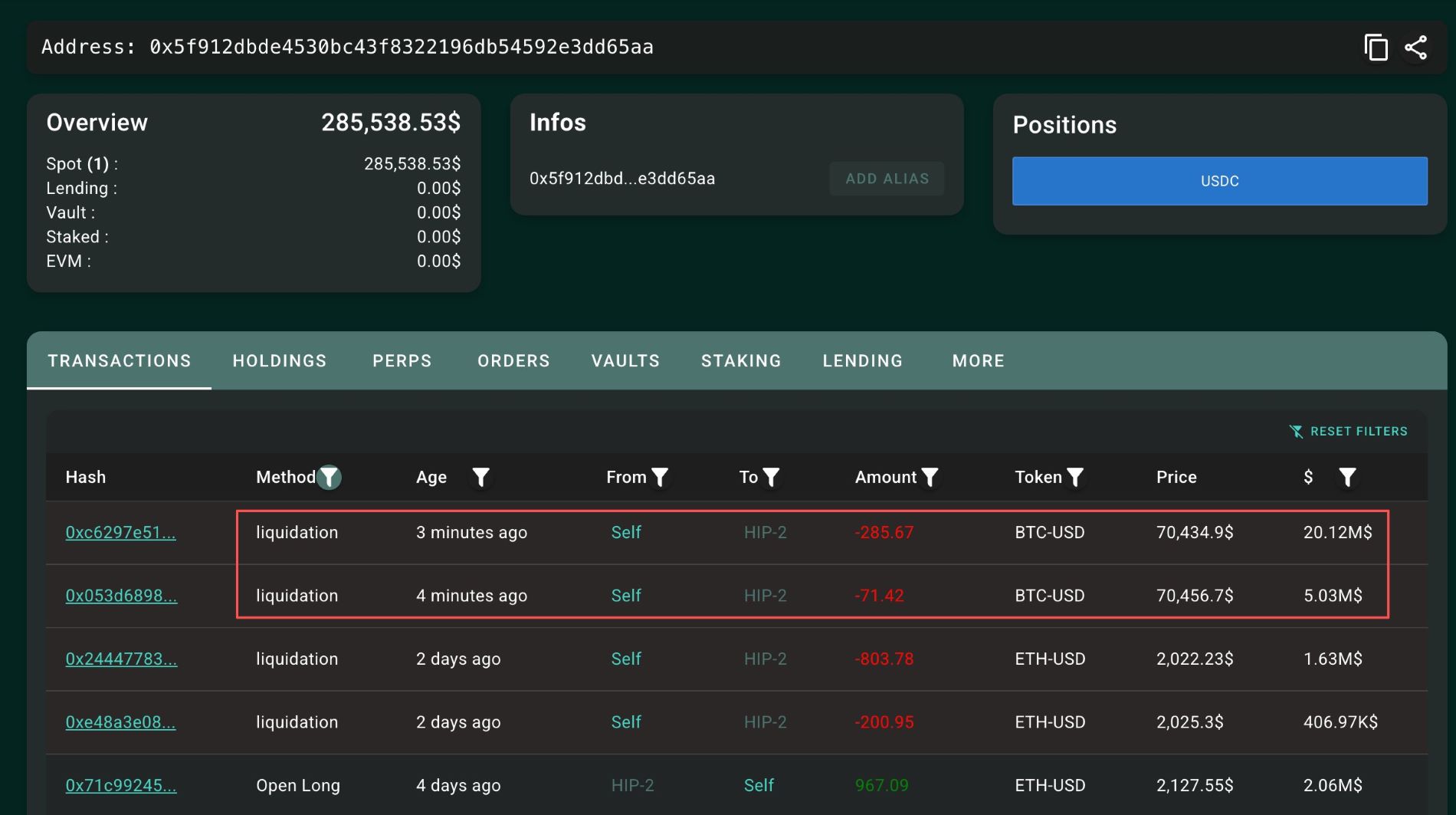
For most liquidation alerts, that would have been the end of the story.
But the wallet behind the trade, 0x5f912dbde4530bc43f8322196db54592e3dd65aa, appeared in another large Bitcoin position shortly afterward.
And according to subsequent trading monitors, the second attempt didn’t end particularly well either.
A $25 Million Liquidation, Then Another $10.7 Million Long
The sequence began at approximately 02:17 UTC.
According to Blockmetric’s Hyperliquid whale monitor, the wallet’s $25.2 million BTC long was liquidated when Bitcoin’s mark price was around $70,439.
The monitor identified the liquidation through position changes and confirmed it with Hyperliquid liquidation fills.
Then, at 03:55 UTC, Blockmetric recorded something unexpected.
The same address had opened another BTC long, this time carrying roughly $10.7 million in notional exposure. Bitcoin’s mark price was approximately $68,790.
That’s a gap of just 98 minutes between the two monitoring observations.
The second position represented about 42.5% of the original $25.2 million exposure.
It was a smaller bet, certainly. But $10.7 million is an aggressive return to the market after a liquidation.
There is an important limitation here: the timestamps come from Blockmetric’s observations, not an independently reconstructed sequence of every execution fill. The reported mark prices also shouldn’t be mistaken for the wallet’s exact entry prices.
Still, the two observations point to a trader returning to the same side of Bitcoin after a substantial forced exit.
The Second Long Didn’t Last Either
The follow-up gets worse.
At 05:56 UTC, WhaleRadar recorded another liquidation involving the same address.
Its report placed the BTC long at roughly $10.7 million, with liquidation occurring near $67,500. The tracker also reported approximately $201,000 in realized losses.
It linked a Hyperliquid transaction as supporting evidence, although the transaction’s individual fills could not be independently inspected for this report.
The $201,000 figure therefore remains tracker-reported rather than an independently reconciled net trading result.
That distinction matters.
A $10.7 million liquidation does not mean the trader lost $10.7 million of their capital. The figure represents the position’s notional exposure, while realized P&L, collateral, and fees measure different parts of the trade.
Hyperliquid’s official liquidation documentation explains that liquidation begins when account equity falls below maintenance margin requirements. Positions may be partially or fully closed, and remaining collateral can be retained depending on how liquidation occurs.
For a closer look at how leveraged perpetual positions work, Ravel previously explained perpetual futures and their funding mechanisms.
A Third Bitcoin Long Appeared
Apparently, two liquidation alerts weren’t enough to end the story.
WhaleRadar subsequently detected another BTC long in the same wallet between 06:20 and 06:31 UTC.
This time, the reported exposure was about $2.5 million, with an indicated entry near $68,700 and leverage of 40x.
The position was just under one-quarter the size of the second long and roughly one-tenth of the original $25.2 million exposure.
However, the exact opening fills and leverage settings have not been independently reconstructed from Hyperliquid’s transaction history.
Nor does the wallet’s behavior establish the trader’s motivation. The address could represent an individual, a trading operation, or another arrangement entirely.
What the monitoring records suggest is a repeated willingness to take leveraged Bitcoin exposure despite successive liquidations.
That is a more revealing finding than the original $25 million alert alone.
Ravel’s earlier investigation into HYPE unlocks and wallet tracking explored a similar lesson: headline numbers often tell only part of the story until the underlying wallet activity is examined.
In this case, the crucial evidence isn’t simply how large the first liquidation was.
It’s what the same address did afterward.
A $25 million long disappeared. A $10.7 million long followed. Another liquidation was reported. Then a $2.5 million long appeared.
Whether the final trade survived remains a separate question requiring updated position and fill data.
But the available records already show why following a wallet beyond its first liquidation alert can change the story completely.