
Quantum computers don’t need to arrive for Quantus to face its first serious financial test. A lending protocol, a price feed, and a market that needs to absorb collateral during a selloff might be enough.
That’s the rather ordinary challenge confronting a blockchain built around an extraordinary threat.
Quantus launched its mainnet on September 9 with a fairly ambitious proposition: money designed to withstand the cryptographic dangers of quantum computing. Its native token, QTC, uses post-quantum digital signatures, while the network combines Proof-of-Work with privacy-focused technology and a Bitcoin-like supply ceiling of 21 million coins.
Now QTC is moving beyond its original purpose.
On October 22, Rhea Finance announced that QTC holders could use their tokens as collateral to borrow other assets, with a maximum loan-to-value ratio of 60%. What began as an experiment in protecting digital money from tomorrow’s computers had found a use in today’s decentralized lending markets.
That’s a meaningful development. But it also introduces an uncomfortable question.
How much of Quantus’ quantum-security narrative survives once its money depends on bridges, external infrastructure, and the liquidity of another blockchain?
The answer is more complicated than either the project’s supporters or skeptics might expect.
Quantum-Safe Money Has to Leave Its Own Blockchain
Quantus has deliberately avoided becoming another general-purpose smart contract platform.
Its technical whitepaper describes a blockchain focused on transferring, protecting, and privately holding money rather than running the sprawling collection of financial applications found on Ethereum or Solana.
That distinction matters.
Quantus uses ML-DSA, a post-quantum digital signature standard, to protect native transactions. However, because the network does not operate a conventional smart contract environment, bringing QTC into lending markets requires external infrastructure.
This is where NEAR comes in.
QTC is represented on NEAR as qtc.omft.near, allowing it to participate in trading and lending applications.
The scale of that integration is already substantial.
During Ravel’s October 29 review, NearBlocks recorded roughly 208,484 QTC issued on NEAR, while CoinGecko reported a circulating supply of around 310,138 QTC.
The quantity represented on NEAR was therefore equivalent to 67.2% of QTC’s reported circulating supply.
That comparison does not mean 67.2% of holders use NEAR, nor does it measure the number of unique investors. It compares a token contract’s issued supply with the circulating supply reported by a market aggregator.
Still, it illustrates how important cross-chain infrastructure has become to QTC’s emerging market.
An independent explorer, QTCScan, also documented a relevant custody trail. On October 8 and 9, the QTC balance attributed to the NEAR Intents bridge account closely matched the quantity issued on NEAR, with a difference of roughly six QTC.
That provides historical evidence supporting the bridge’s reserve accounting. It is not a real-time proof-of-reserves audit, and QTCScan explicitly identifies its service-account labels as interpretations of on-chain activity rather than confirmations from the operators.
The more interesting complication lies deeper in NEAR’s infrastructure.
In its August post-quantum roadmap, NEAR explained that ML-DSA signatures were already supported for user accounts. But the network had not yet completed its transition to post-quantum security across consensus and cross-chain systems.
On October 23, NEAR announced another security milestone: Chain Signatures operations were running inside trusted execution environments, with an MPC network of 17 independent operators and a signing threshold of 11.
That’s real progress, not something to dismiss.
Yet the same technical announcement acknowledged that practical post-quantum threshold signing was still at least a year away from production readiness. Certain confidential key-derivation components also continued to rely on cryptographic assumptions that were not post-quantum secure.
Importantly, those statements concern NEAR’s broader infrastructure. They do not establish the exact signing and custody configuration of every operation involving QTC, nor prove that its particular bridge implementation is vulnerable.
What they establish is a security boundary.
A blockchain can protect its native transactions with post-quantum cryptography without automatically extending identical protection to every external system handling its assets.
And once QTC becomes lending collateral, cryptographic security is only one piece of the equation.
Rhea Opened the Lending Market. The Numbers Tell a Smaller Story
The arrival of QTC on Rhea creates a simple new proposition for holders: instead of selling their coins to unlock capital, they can potentially borrow against them.
Rhea announced a maximum LTV of 60%. In theory, $10,000 in collateral could support a loan of up to $6,000. However, actual borrowing capacity depends on the market’s limits and risk parameters.
But the headline borrowing limit tells us little about how much credit is actually being created.
Ravel examined Rhea’s public lending dashboard to establish a starting point.
The October 29 snapshot showed roughly 3,600 QTC supplied to the market, worth $287,160. Another 258.21 QTC, valued at $20,600, was recorded as borrowed.
That translates into a utilization rate of about 7.17%.
The supplied QTC represented just 1.16% of the token’s reported circulating supply. In dollar terms, it accounted for only 0.135% of Rhea’s $212.38 million in total supplied assets.
Those are modest numbers for a cryptocurrency attracting attention around its technology and expanding DeFi integrations.
But there’s a catch.
The $20,600 in borrowed QTC is not the amount borrowed against QTC collateral.
It measures QTC borrowed from the protocol, which is a different activity from borrowing USDC or another token while pledging QTC as security.
Rhea’s own lending instructions also distinguish supplying an asset from enabling it as collateral. Depositors can provide assets without necessarily using them to support a loan.
That means we cannot automatically count the $287,160 in supplied QTC as collateral backing active debt.
Without a complete account-level breakdown of QTC collateral positions and their corresponding liabilities, the actual volume of credit generated through QTC-backed borrowing remains unverified.
It’s a distinction worth making because a lending market can look active from its aggregate supply figures while generating very little borrowing demand.
Conversely, the relatively small QTC supply figure doesn’t prove the market is failing. The integration is still young, and its adoption could change rapidly.
For now, the evidence supports a narrower conclusion: QTC has gained access to decentralized credit markets, but public data still doesn’t show how much borrowing QTC collateral actually supports.
That brings us to the third, and arguably more immediate, test.
The $10.5 Million Liquidity Headline Has a Catch
A lending market is only as resilient as its ability to value and liquidate collateral when conditions turn against borrowers.
For QTC, understanding that resilience means looking beyond the total liquidity figures displayed on trading dashboards.
During the same October 29 review, GeckoTerminal’s Rhea QTC/USDC market showed roughly $10.5 million in reported liquidity.
On paper, that looks promising for a token with a market cap near $25 million.
But the composition tells a different story.
About $8.38 million of the reported pool value was denominated in QTC itself, compared with roughly $2.14 million in USDC.
In other words, nearly 80% of the displayed inventory value was the very asset whose liquidity investors might eventually need to test.
This doesn’t make the pool ineffective. It does, however, make its total dollar value a poor standalone measure of how much selling pressure it can absorb.
CoinGecko’s market data offered another useful reference point. The Rhea QTC/USDC pair showed roughly $210,000 in downside market depth within 2% of the prevailing price.
That figure was equivalent to just 2% of the pool’s reported value.
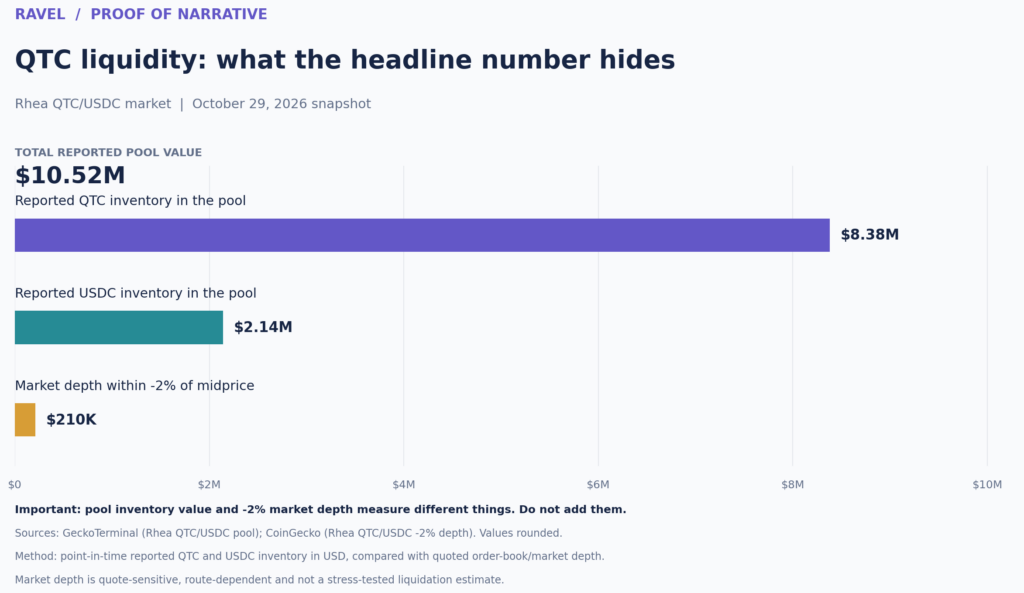
These two metrics measure different things. Pool liquidity describes the value of assets associated with a market, while downside market depth estimates executable liquidity within a specified price range. Neither is a direct measurement of liquidation capacity under stress.
Still, their contrast matters.
A $10.5 million liquidity figure should not be interpreted as a promise that a liquidation engine can sell $10.5 million of QTC without materially affecting its price.
Other execution routes may offer additional capacity, and liquidity can shift as market makers respond. The correct test would require executable quotes for defined QTC sale sizes, including fees, slippage, and available routes.
There is another complication.
GeckoTerminal also displays QTC markets routed through NEAR Intents. During Ravel’s review, the reported QTC quantities across the Rhea QTC/USDC market, a NEAR Intents QTC/USDC pair, and a QTC/wNEAR pair added up to roughly 298,000 QTC.
That’s substantially more than the 208,484 QTC reported as issued on NEAR.
This apparent discrepancy should not be interpreted as evidence of unauthorized token creation.
The figures describe reported market-level inventory, not independently reconciled balances held in three exclusive custody accounts. Differences in market representation, liquidity routing, and data-provider methodology may explain why adding them produces a figure exceeding the token’s issued supply.
But without matching those reported quantities to actual account-level holdings, the precise source of the discrepancy remains unresolved.
The implication is straightforward: treating every displayed market liquidity figure as separately available capital risks overstating the amount of inventory that can actually absorb selling pressure.
Rhea itself describes NEAR Intents as an execution system in which competing solvers fulfill requested trades, drawing liquidity from supported routes.
That architecture can improve execution by allowing orders to access liquidity beyond a single conventional pool. It also means assessing realistic exit capacity requires more than simply adding market statistics.
There is a financial valuation dimension here, too.
At around $80 per QTC, the roughly 310,000 circulating tokens translated into a market cap close to $25 million. Yet the project’s maximum supply is 21 million QTC.
Multiplying that maximum supply by the same spot price produces a hypothetical valuation near $1.68 billion.
This is not a forecast, nor does it imply that all 21 million tokens will enter circulation soon. Much of Quantus’ genesis allocation is subject to vesting, while future mining issuance follows its monetary schedule.
It does illustrate how differently a token can appear when viewed through its current circulating float rather than its eventual supply ceiling.
For investors, that matters because collateral risk is shaped not only by the price visible today but also by the depth, concentration, and changing availability of the market supporting that price.
This does not establish that QTC is incorrectly priced, that Rhea’s risk parameters are unsafe, or that Quantus has failed to deliver its cryptographic protections.
The available data doesn’t support those conclusions.
What it shows is something more useful: a project whose post-quantum design is becoming economically dependent on systems that must solve their own, very different security and liquidity problems.
Quantus set out to protect digital money from a future in which today’s cryptography could become obsolete. Its transition into DeFi now gives the market a way to test something more immediate.
Can that money move securely, support meaningful credit, and find buyers when collateral needs to be sold?
Quantum computers may still be years away from answering the first question Quantus was built around.
The market doesn’t have to wait that long to answer the others.