


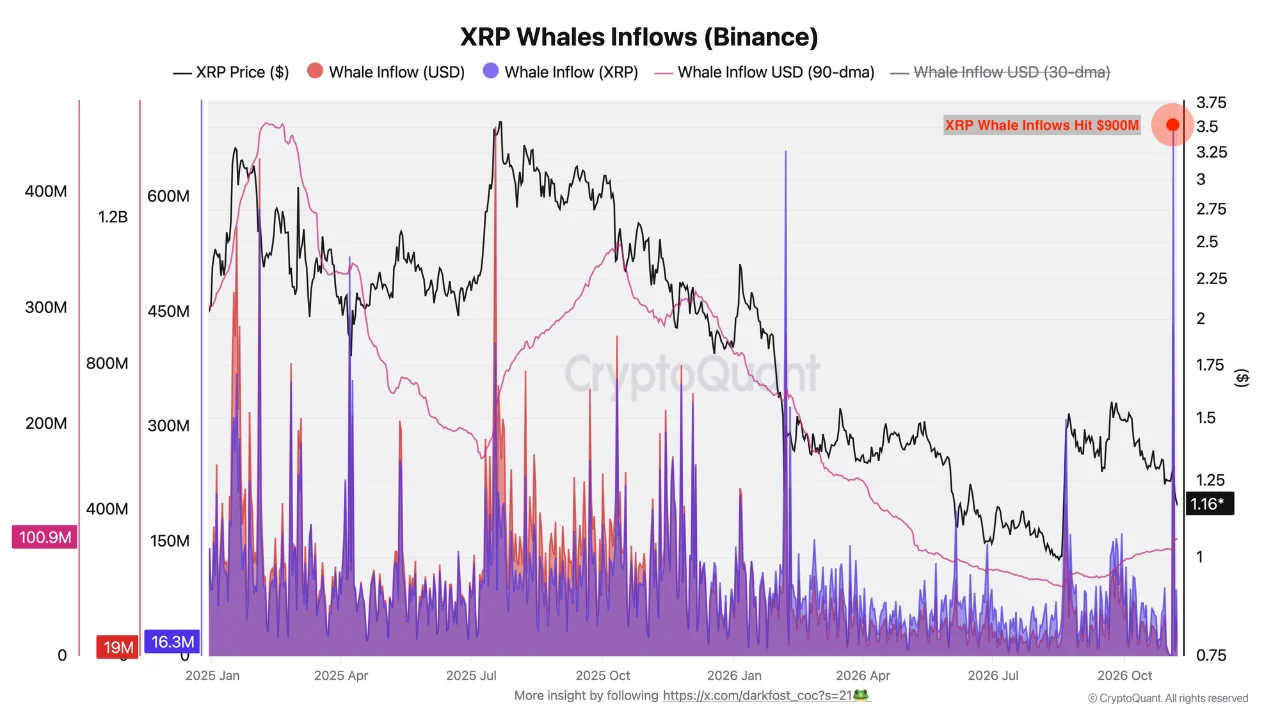
XRP whales sent more than $900 million to Binance, the kind of transfer that usually gets traders reaching for the sell button. But the latest exchange data introduces an interesting twist: Binance wasn’t where depositor-wallet counts surged.
As XRP struggled below $1.30, large holders transferred around 691 million tokens to Binance in a single day. According to CryptoQuant analyst Darkfost, it was the largest daily whale inflow since 2024, surpassing even February 2026’s capitulation episode.
That certainly looks like trouble for XRP.
Except another set of numbers suggests the market’s activity was spreading far beyond Binance.
Thousands of XRP Depositor Wallets, But Not on Binance
On November 10, CryptoQuant contributor Amr Taha reported a striking difference in XRP wallet activity across major exchanges.
On November 9, Coinbase recorded 2,485 more depositing wallets than withdrawing wallets. Bybit registered a net difference of 1,370, while Crypto.com added another 889.
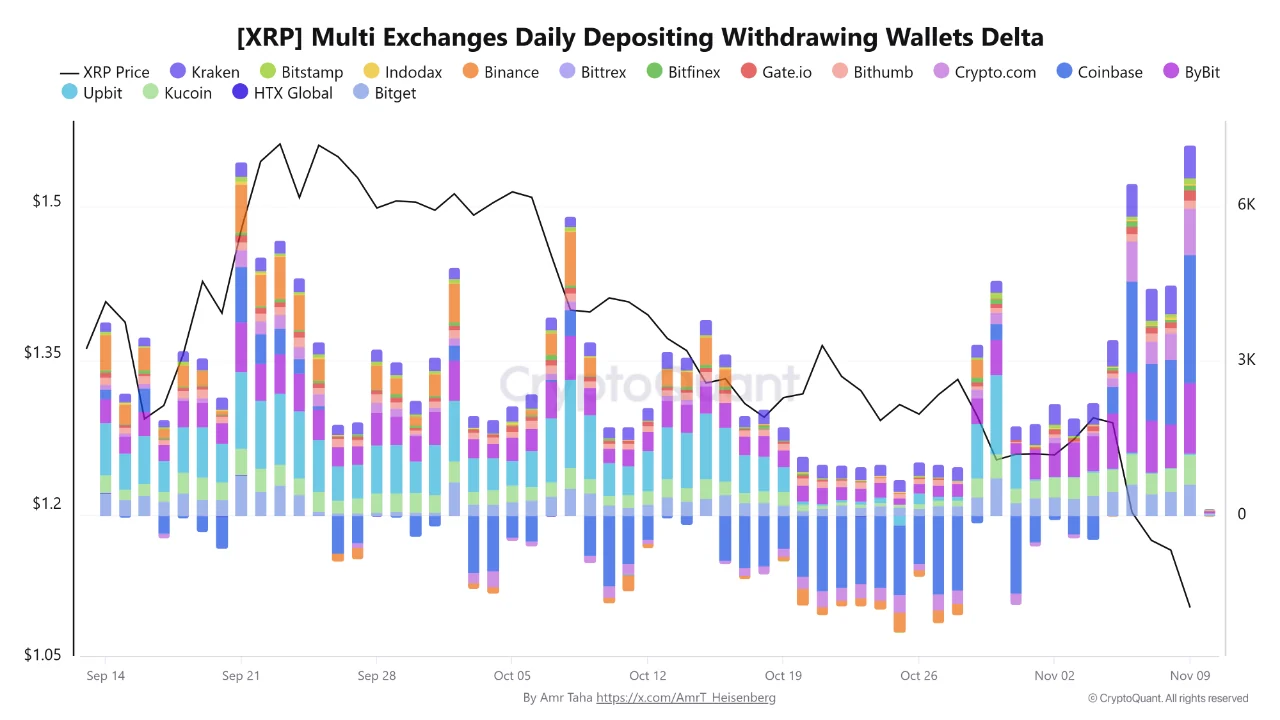
Combined, those three exchanges recorded a positive difference of 4,744 wallets, their strongest reading since August 20.
Binance? Just two.
The contrast becomes more interesting when trading volume enters the picture.
Between October 28 and November 9, XRP’s seven-day average daily spot volume climbed from $513 million to $786 million, an increase of 53.2%.
But Binance accounted for only $67 million of that increase. The other tracked exchanges contributed $206 million.
Ravel’s calculation: 75.5% of the increase in average daily XRP spot volume came from outside Binance.
In other words, the exchange receiving the headline-grabbing whale transfers wasn’t responsible for most of the broader growth in trading activity.
That doesn’t mean traders elsewhere were buying XRP. Every completed spot trade has a buyer and a seller, while depositing tokens doesn’t establish whether they were subsequently sold.
It does show why focusing exclusively on Binance’s whale transfers risks missing the wider market.
The $900 Million Question
There is another complication.
The whale inflow and depositor-wallet figures measure different things across different observation periods. One tracks the amount of XRP transferred by large holders. The other counts the difference between wallets depositing and withdrawing XRP.
A wallet transferring millions of tokens can outweigh hundreds of smaller deposits.
CryptoQuant also raised another possible explanation for Binance’s unusually large inflows: reserve replenishment following the October 29 security breach.
That incident has already produced consequences far beyond the exchange itself. Ravel previously examined how the Binance hacker’s activity triggered an emergency freeze across 292 Aave reserves.
The exchange’s recovery efforts also highlighted the difference between freezing stolen cryptocurrency and actually recovering it.
Still, the available XRP data cannot establish how much of the whale inflow reflected reserve management, customer transfers, or outright selling.
That distinction is the story.
XRP’s trading activity is expanding, depositor-wallet counts are rising on several exchanges, and whales have moved an enormous quantity of tokens onto Binance.
All three developments can coexist without proving the same market narrative.
The $900 million transfer tells us where the XRP went. It doesn’t tell us who sold it.